Ask small business owners in India why they haven't "gone digital" properly, and very few say they don't see the point. They say they don't know where to start, they paid for something once and never saw a customer from it, or they simply don't have time to manage another thing. A CMR study reported by CIOL found that 26% of MSMEs lack internal digital expertise and 20% can't identify the right technology to adopt. The problem isn't ambition. It's that nobody has broken the job into steps an owner can act on.
This guide does that: where to start, in what order, what to expect to pay, how to avoid the common traps with vendors, and how to know whether any of it is working.
Start from how customers already find you
Every expert pushes a different first step: a website, Instagram, SEO, ads, a WhatsApp catalogue. Most owners end up doing several of them half-heartedly. The right order depends on how your customers already look for businesses like yours.
Write down the last 20 new customers and how each one found you: a referral, a walk-in, a Google search, Google Maps, Instagram, a marketplace, a directory like Justdial. The pattern tells you where to put effort first. A clinic that gets most patients from "near me" searches needs a strong Google Business Profile before anything else. A boutique that sells through Instagram DMs needs WhatsApp Business and a simple catalogue. A B2B manufacturer that wins work through referrals needs a credible website that referrers can send people to.
The foundation, in a sensible order
For most small businesses, this order works:
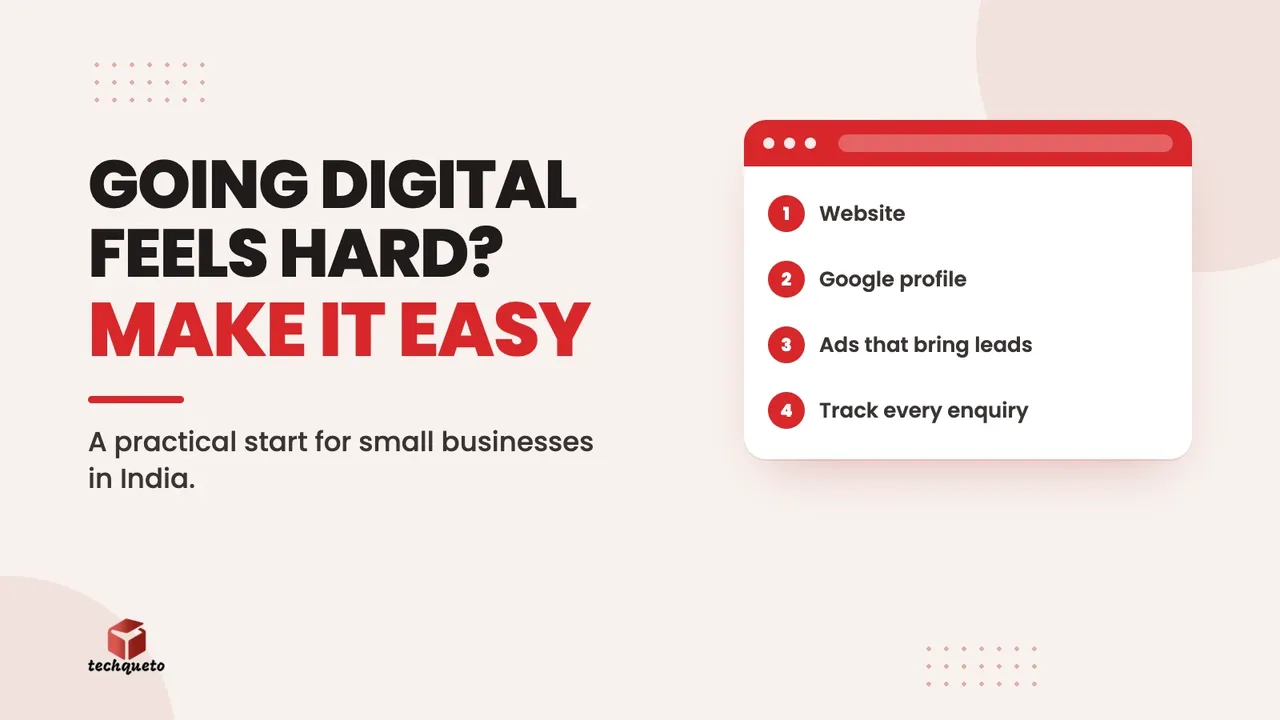
- Google Business Profile. Free, and for any business with a location or service area, the single biggest source of local enquiries. Fill in every field, add real photos and start collecting reviews. Our Google Business Profile guide walks through it.
- WhatsApp Business. A business profile with your hours, address and a catalogue, quick replies for common questions, and labels to track enquiries. Most Indian customers would rather message than fill in a form.
- A simple website. Not a 40-page project: a fast, mobile-friendly site with what you do, where, prices or price ranges where possible, proof (photos, reviews, past work) and a clear way to call or message. It's the place that makes you look established when someone checks you out.
- One social channel done well. Choose the one your customers use, post consistently, and link it to your website and WhatsApp. Being active on one beats being abandoned on four.
- Paid ads, last. Ads multiply whatever is underneath them. Run them once the profile, website and enquiry handling are working, or you pay to send people to a weak first impression.
The order matters because each step feeds the next. Big Wheels Cars, a pre-owned car retailer on our work page, shows where it leads: the work there is ongoing social-media management and digital presence, which is step 4 run as a steady routine rather than a burst of posts.
What it should cost, and how to get a clear quote
Owners often delay because they have no idea whether ₹15,000 or ₹1,50,000 is reasonable for a website. Both can be, for very different scopes. What protects you is a quote broken into deliverables rather than a vague monthly figure:
- the number of pages and what each one contains,
- features such as enquiry forms, WhatsApp buttons, booking, payments or a product catalogue,
- who writes the content and supplies the photos,
- the timeline, and how many rounds of changes are included,
- what happens after launch: hosting, updates, backups and support, with their yearly cost.
If a vendor can't break their price down like this, treat it as a warning before you've spent anything. For running costs, budget for the domain, hosting and maintenance each year, and for your time or someone's fee to keep the profile and social channel active.
Avoid getting burned: own your accounts
Many small businesses have a half-built website from a freelancer who disappeared, or a page nobody can log into any more. The most important protection costs nothing: make sure the business owns every account.
- Domain name: registered in the business's name, with your email as the account owner.
- Hosting and website admin: you have the login, even if someone else manages it.
- Google Business Profile, Google Analytics, Search Console and ad accounts: your Google account is the owner, and vendors are added as managers. Google's help page on Business Profile owners and managers explains why: owners can add or remove users and even delete the profile, so that role should stay with you.
- Social pages and WhatsApp Business: owned through your own Meta Business account.
When you work with an agency or freelancer, ask for one person who is responsible for delivery end to end, and a written plan for after launch: who updates the site, who replies to enquiries, who reports results and how often. A vendor who resists giving you ownership of your own accounts is telling you something.
Decide what you'll measure before you spend
The fastest way to lose faith in digital is to spend money, see no obvious change, and conclude it "doesn't work for us". Often the real issue is that nothing was being measured, or that the website was built to look good rather than to generate enquiries.
Agree on the numbers before anything is built: phone calls, WhatsApp enquiries, form submissions, direction requests from Google Maps, and orders if you sell online. Ask whoever builds the website to show you where each one is tracked. Then keep a simple monthly sheet with those numbers next to what you spent. Three months of that sheet tells you more than any report full of impressions and reach.
Keep it running without it taking over your week
Going digital isn't a project with an end date; it's a few small habits:
- Daily: reply to enquiries on WhatsApp and calls quickly, ideally within the hour during business hours.
- Weekly: reply to new reviews, add a photo or post to your Google Business Profile, and post on your one social channel.
- Monthly: check the numbers sheet, update prices or offers on the website, and make sure everything still works on a phone.
- Yearly: renew the domain and hosting, review what's bringing customers, and decide where to invest next.
If you hand any of this to someone else, keep the daily reply to enquiries close to the business. Customers can tell when the person answering doesn't know the work.
Common mistakes to avoid
- Doing everything at once. Five half-finished channels look worse than two that are active and up to date.
- Paying for ads before the basics work. If enquiries go unanswered or the website is slow on a phone, ads only make the leak bigger.
- Copying a competitor's website. Customers notice, and it does nothing to explain why they should choose you.
- Leaving prices and hours out of date. A wrong number or old timing costs trust faster than having no listing at all.
- Judging too early. Profiles, reviews and search visibility build over weeks and months; give each step a fair test before deciding it doesn't work.
A 90-day starting plan
- Weeks 1–2: list how your last 20 customers found you; claim and complete your Google Business Profile; set up WhatsApp Business properly.
- Weeks 3–6: get two or three fixed-scope website quotes, choose one, and make sure every account is in the business's name.
- Weeks 7–10: launch the website with calls, WhatsApp and forms tracked; start asking every happy customer for a review.
- Weeks 11–13: review the numbers sheet; if enquiries are being handled well, test a small, focused ad campaign.
None of these steps requires technical knowledge, only a clear order and someone accountable for each one. Small businesses that go digital this way rarely need to start over, because each step builds on the one before.