Every year the same thing happens: Diwali gets close, your Meta ads reach drops, and the instinct is to raise the budget to "keep up". This year Diwali falls on 8 November, and planning guides estimate that Meta ads CPM for Diwali 2026 will climb 40–70% in the weeks leading up to it, according to Purple Circle's festive CPM guide. If you chase reach at any price, you can end up busier than ever and earning less. Here is a simpler method: work out the highest CPM your business can afford, and let that number, not your fear of missing out, set your budget.
Why Meta ads CPM jumps before Diwali
CPM is what you pay for 1,000 impressions. In the festive weeks, fashion, jewellery, electronics, home décor, beauty and gifting brands all bid for the same shoppers on the same phones. More bidders chasing the same attention means a higher price per thousand impressions. Navratri has already started, and ad costs typically rise from mid-October as more advertisers go live.
The mistake is treating this as a reach problem. Reach is a cost, not a result. A brand that pays 60% more per impression needs 60% more orders per impression just to stand still. If it doesn't get them, every rupee of extra spend makes the profit line worse.
Do this: Stop asking "how do we hold our September reach?" and start asking "what is the most we can pay per 1,000 impressions and still make money?"
Step 1: Recalculate your break-even CAC for festive conditions
Break-even CAC (customer acquisition cost) is the most you can spend to win one order before that order loses money. In September it might be a clean number. In festive season it shrinks, because discounts are deeper, cash-on-delivery share rises and returns (RTO) eat margin.
Work it out from your real numbers: selling price, minus product cost, packaging, shipping, payment fees, the festive discount, and an allowance for returns. What is left is the most you can spend on ads for that order.
Do this: Redo the calculation with festive prices and festive return rates. Do not reuse the September figure.
Step 2: Calculate your maximum affordable CPM
Here is the formula:
Maximum CPM = break-even CAC × CTR × conversion rate × 1,000
CTR is the share of people who click your ad. Conversion rate is the share of clickers who buy. Both come from your own ad account and store analytics, not from industry averages.
Do this: Pull the last 14 days of CTR and conversion rate for your best-performing campaign and plug them in.
A worked example (illustrative numbers, not client data)
This example comes from the same Purple Circle guide and is a fictional kurti brand. Treat the rupee figures as an illustration of the method.
- Break-even CAC: ₹520 per order before ads.
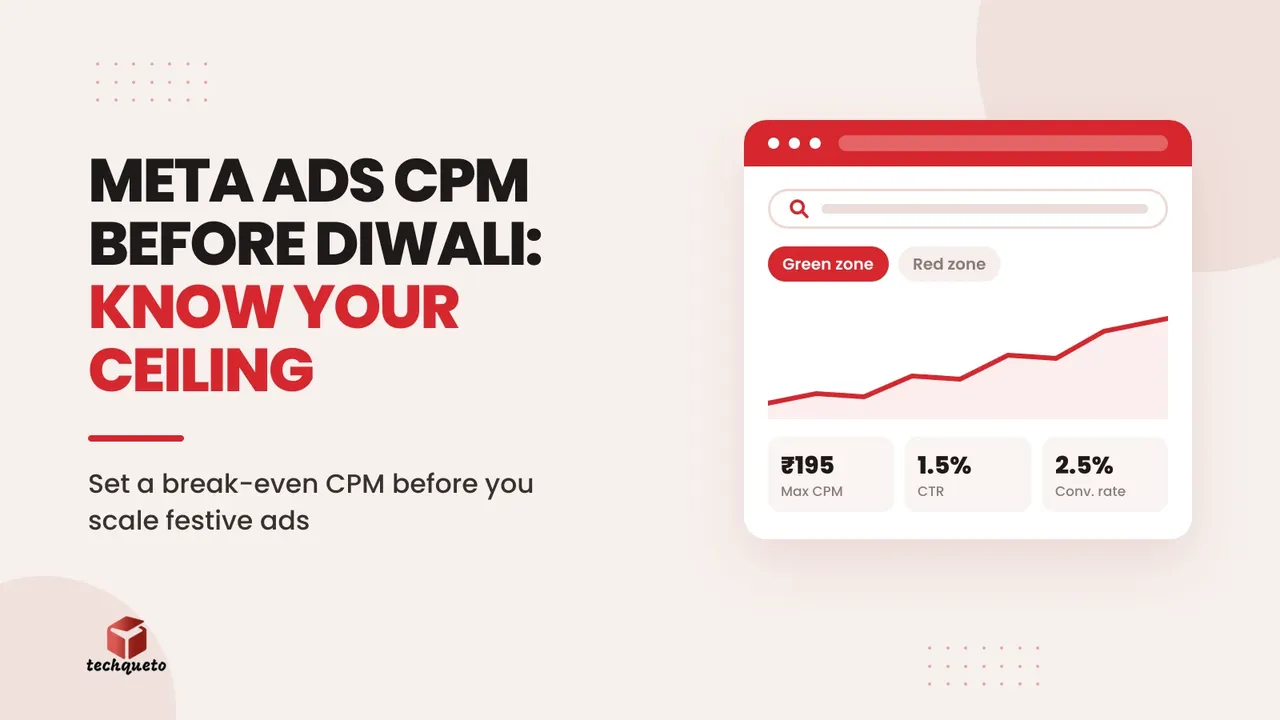
- CTR: 1.5%. Conversion rate: 2.5%.
- Maximum CPM: 520 × 0.015 × 0.025 × 1,000 = ₹195.
Now compare September with festive:
- September: ₹15,000 a day at a ₹120 CPM. Each order costs about ₹320 in ads, which leaves ₹200 profit per order and roughly ₹9,375 a day.
- Festive, same conversion rate: to hold reach, spend rises to about ₹27,000 a day, and CPM rises to ₹192. That is just under the ceiling, but each order now costs about ₹512 in ads. Profit falls to roughly ₹422 a day.
- Festive, conversion rate lifted to 3%: the same ₹192 CPM now costs about ₹427 per order, and profit rebounds to about ₹5,906 a day. The ceiling also rises to ₹234.
Even after the conversion lift, profit is about 37% below September. The lesson is not that festive ads don't pay. It is that the extra spend only works when each impression earns more, and you can see that coming before you spend.
Do this: Run your own version of these three scenarios in a spreadsheet before you set festive budgets.
Step 3: Turn the ceiling into green, amber and red zones
A single number is hard to act on in a busy week. Split it into zones, using 80% of the ceiling as a profit cushion. In the example above, that gives:
- Green (scale): up to ₹156. Spend more, in steps.
- Amber (hold): ₹156–₹195. Keep budgets steady and improve the creative or offer.
- Red (pull back cold prospecting): above ₹195. Every new order from cold audiences now loses money.
Do this: Write your three zone numbers on a sticky note, or in the first row of your reporting sheet, and check CPM against them every two to three days.
Step 4: Raise purchases per 1,000 impressions before you raise spend
When CPM is out of your control, the lever you do control is how many purchases each 1,000 impressions produce. A few practical ways to lift it:
- Fresh festive creative. Short vertical video with a clear offer and a deadline beats last month's static banner. Test in the first half of October, before CPMs peak.
- A festive bundle. Higher order value raises your break-even CAC, which raises your ceiling. Our guide on fixing the leak in your ad funnel shows where clicks get lost after the ad.
- A festive landing page. Send traffic to a collection page, not your homepage.
- Faster mobile checkout. Most festive shoppers buy on phones. If the site feels slow, see our post on INP and Core Web Vitals.
Do this: Pick one conversion lever this week and measure it for three days before changing anything else.
Step 5: Scale slowly, and keep retargeting running
Meta's learning phase can be disrupted by big edits. Jon Loomer, an independent Meta ads educator, notes that how much an increase matters depends on the size of the budget increase, so large overnight jumps are a risk you don't need to take.
- Raise budgets in 20–30% steps, and only while CPM stays in the green zone.
- Pull back cold prospecting when CPM crosses your ceiling.
- Keep retargeting and past-buyer campaigns running. These audiences are warm, so they convert better and stay profitable even when cold CPMs are high.
- Use WhatsApp and email for existing customers. Our Click-to-WhatsApp ads guide for Diwali shows how to turn chats into sales.
Do this: Weight the last two to three weeks toward remarketing and branded search, where your cost per order is lowest.
Step 6: Check tracking before you scale
None of these zones mean much if your data is wrong. Confirm that the Meta Pixel and Conversions API are firing on the purchase event, and that the orders in Ads Manager roughly match the orders in your store. Also track blended revenue divided by total ad spend, next to platform ROAS, so you are not relying on Meta's own attribution alone.
Do this: Place a test order today and confirm it appears in both Ads Manager and your store.
A simple festive checklist
- Recalculate break-even CAC with festive discounts and returns.
- Calculate the maximum CPM and set green, amber and red zones.
- Test 3–5 creative concepts before CPMs peak.
- Send traffic to a festive landing page with a clear deadline.
- Scale in 20–30% steps and check every 2–3 days.
- Keep retargeting on, and pause cold campaigns in the red zone.
- Plan the post-Diwali budget pullback now, so spend doesn't keep running after demand drops.
The bottom line
Rising CPMs are not a reason to panic or to overspend. They are a reason to know your numbers. Set your break-even CPM ceiling, scale only inside it, and put your effort into making every impression more likely to turn into an order. That is how you reach 8 November with sales and profit, not just a big ad bill.
Need help with this? Get in touch with Techqueto — we build and grow websites for 100+ brands across India and the UAE. Ready to get started? Get started here.