Every week there is a new launch, and every week a client asks whether your team is "using AI". The honest answer for most agencies is a scattered set of free trials and three tabs nobody pays attention to. This guide shows how to choose AI tools for marketing agencies in India without wasting money: decide the tasks first, pay only for what saves billable hours, and set guardrails before any client data goes in.
Start with tasks, not tools
Most agencies pick a tool, then hunt for a use. Flip it. List the jobs your team repeats every week, then ask which ones are mostly assembling, summarising or reformatting. Those are the ones AI handles well. Anything that needs judgement about a client's market, or a relationship, stays with a person.
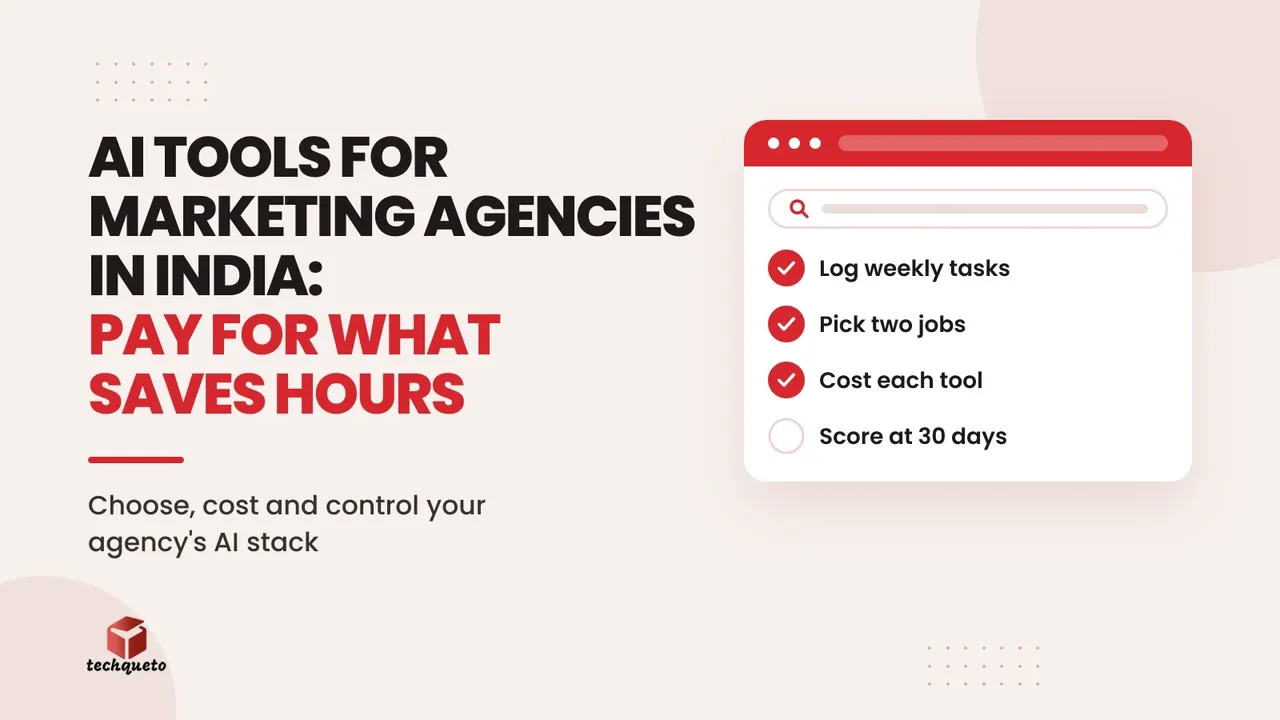
A quick way to do this is a one-week time log. Ask each team member to note every task that took more than 30 minutes and tag it as "assemble", "think" or "talk". Only the "assemble" tasks are automation candidates.
Do this: Run the one-week time log before you open a single pricing page. Shortlist the five "assemble" tasks that eat the most hours.
The five jobs worth automating first
Across most small and mid-sized agencies, the same tasks come up again and again. These are the ones where a general AI assistant typically pays for itself fastest:
- First drafts of reports. Turn exported ad or Search Console data into a plain-language summary a human then edits and signs off.
- Ad copy variations. Generate ten headline and primary-text options from an approved brief, then pick and refine three.
- Meeting notes and briefs. Convert call transcripts into action lists and client-ready briefs.
- Keyword and content outlines. Draft structures for blog posts and landing pages that a writer then owns. Our post on Claude for SEO workflows covers six safe ways to do this without risking rankings.
- Repetitive creative resizing and versioning. Adapt one approved design into the formats each platform needs.
Do this: Pick two of these five, not all five. Two done well beat five done badly, and you will learn what your team actually needs.
What to pay for and what to leave free
Free tiers are fine for testing, but they usually come with limits on usage, privacy or both. Paid plans make sense when a tool is used daily by several people, handles client material, or offers admin controls such as shared workspaces and data-retention settings.
Prices are also moving. Meta's new Muse for Small Business, for example, is reported to be free for most uses, with paid tiers at $20 and $100 per month, according to the MarketingProfs AI update for 2 October 2026. Pricing like this can change quickly, so treat any number you read, including that one, as a starting point and check the vendor's page before budgeting.
For model choice, you do not need to chase every release. Our comparison of Claude vs ChatGPT for marketing explains how to test two assistants on your own work before committing.
Do this: Give each paid tool a 30-day trial with one named owner and one measurable job. If nobody can say what it saved, cancel it.
A worked example: what a stack costs against what it saves
Here is an illustrative example, not a benchmark. Assume an agency with 12 clients where three team members each spend about 6 hours a week on report drafts, ad copy variations and meeting notes.
- Assume AI cuts that work by 40% after review time is included: 6 hours × 40% = 2.4 hours saved per person per week.
- Across three people that is 7.2 hours a week, or roughly 31 hours a month.
- Assume the team's internal cost is ₹400 per hour. Time recovered is worth about ₹12,400 a month.
- Assume the tool spend is ₹6,000 a month across the team.
- The example net gain is about ₹6,400 a month, before counting any extra client capacity you can sell.
The numbers here are made up to show the method. The point is the structure: hours saved after review, times your real hourly cost, minus real tool spend. If the result is negative with your honest inputs, the tool is not ready for your agency yet.
Do this: Replace every assumption above with your own numbers from the time log, then repeat the sum for each tool you are considering.
Keep humans on the work that wins clients
AI is good at volume and speed. It is weaker at the things clients actually pay for: knowing why a campaign behaves the way it does, reading a market, and telling a founder something unwelcome. Generic output also carries a brand risk. We covered how identical-looking AI visuals erode trust in AI slop branding, and the same applies to copy that sounds like everyone else's.
A simple rule works well: AI can draft, a person must decide. Every client-facing deliverable gets a named human reviewer who is accountable for it.
Do this: Add a "reviewed by" line to your internal checklist for reports, copy and creative so that no AI draft goes out unseen.
Set guardrails before you scale
Agencies hold client data that does not belong in a public tool: ad account exports, customer lists, unreleased campaigns. Decide the rules now, while the stack is small.
- Data rule. Never paste personal data, customer lists or confidential financials into a tool unless its settings and your client contract allow it.
- Approval rule. Tell clients where AI is used in their work, especially for copy and creative, and get written agreement where your contract requires it.
- Accuracy rule. Verify every figure, claim and quote an AI produces before it reaches a client. Never publish a statistic you cannot trace to a source.
- Account rule. Use company-managed accounts, not personal logins, so access ends when someone leaves.
Regulators are also paying attention: the same MarketingProfs roundup reports that the US FTC has opened an industry-wide probe into AI-agent risks. Indian rules will keep evolving too, so keep your policy short and review it every quarter.
Do this: Write the four rules above on one page, share it with the team this week and add it to client onboarding.
Run a 30-day scorecard
Do not decide on feelings. Score each tool after 30 days against four questions:
- Did it save measurable hours after review time?
- Did quality hold up in client feedback and revisions?
- Did the team actually use it without being reminded?
- Did it respect your data and approval rules?
Keep tools that pass at least three. Drop the rest and re-test only if something material changes. This also gives you a clean answer when a client asks what your AI process is, backed by numbers rather than hype.
Do this: Put a calendar reminder 30 days out for every paid tool, with the scorecard questions attached.
The bottom line
The best AI stack for a marketing agency is usually smaller than you expect: two or three tools tied to specific jobs, a named human reviewer, a one-page data policy and a monthly look at whether the numbers still work. Start from your own time log, cost each tool honestly, and keep the judgement that clients pay for in human hands. Agencies that do this will use AI to take on more clients without losing quality.
Need help with this? Get in touch with Techqueto — we build and grow websites for 100+ brands across India and the UAE. Ready to get started? Get started here.