On 15 October 2026, Google announced changes to how AI Mode and AI Overviews link out to websites. For anyone doing AI Mode SEO, this is the first update in a while that is good news: more inline links, shown higher in the answer, and a test of a section that points to official sites. It does not mean the traffic loss from AI answers is over. It means the links that do appear are worth fighting for, and the businesses that are clear, trustworthy and easy to quote are the ones most likely to get them.
Here is what changed, and a practical plan for Indian businesses to earn the click.
What Google actually announced
According to Google's own post on AI Mode and AI Overviews, the update includes:
- More inline links: links embedded in the answer text, shown higher in responses more often.
- An official-sites section (in testing): a dedicated block at the top of some answers that highlights one or two official pages for a task, with a note on why each is useful.
- News carousels: prominent article carousels rolling out to more locations and languages, which also highlight Preferred Sources.
- Better end-of-answer links: related article links with image thumbnails and a more clickable design.
- Clickable creator names (in testing): creator and publisher names on video results in AI Mode link to their Search profiles.
Google also said the number of people using Preferred Sources has grown by more than 7x since the start of 2026. Google gave no click-through numbers in this announcement, so treat any claim of "X% more traffic" with suspicion. Independent data still points the other way: a PPC Land summary of the announcement cites a July 2026 study of 1,065 US participants that found AI Overviews cut outbound organic clicks by 39.8%. The fair reading is that links are getting more visible, but fewer people click overall, so each link you earn matters more.
Be the "official" page for what you do
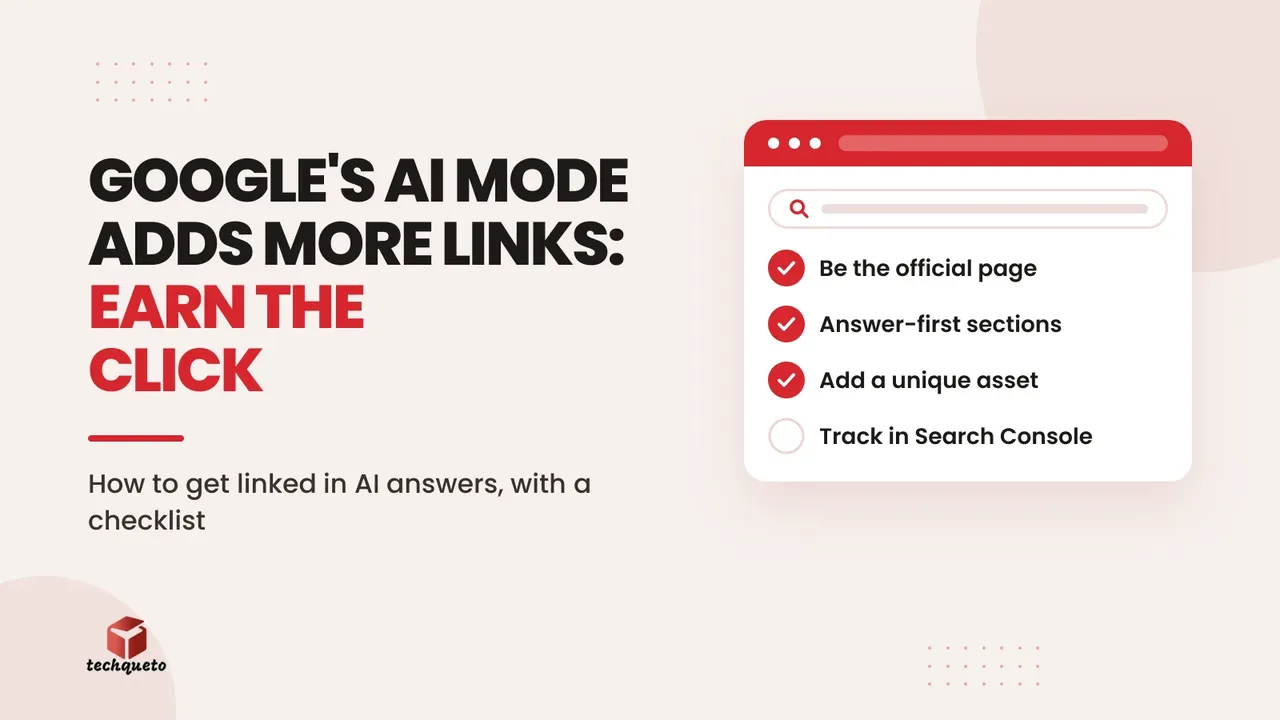
The official-sites test is the most interesting part for small and mid-sized businesses. If Google highlights one or two official pages for a task, you want to be one of them for your own brand, services and locations.
Make it unambiguous who you are: a clear About page, a Contact page with the same name, address and phone number everywhere, and a Google Business Profile that matches your website. Add Organization or LocalBusiness schema so Google can connect the dots. Our guide to local SEO in Google's AI Mode covers the profile side in detail.
Do this: open your homepage and your top service page and ask, "If I were Google, would I be sure this is the official page for this business and service?" Fix anything that creates doubt, such as mismatched business names, old phone numbers or a missing address.
Write sections that are easy to link
Inline links usually attach to a specific claim or step inside an answer. That favours pages that state things plainly. A page that buries its answer under four paragraphs of warm-up gives an AI system nothing clean to point to.
Structure each page so every ## section answers one question, with the answer in the first two sentences, followed by the detail. Use real specifics: prices as ranges, timelines, process steps, what is and is not included. Vague marketing copy rarely gets cited.
Do this: pick your five highest-value pages and rewrite each section opening as a direct answer. Keep the detail below it.
Turn your best pages into the source, not the summary
If an AI answer can fully replace your page, the user has no reason to click. The pages that still earn clicks offer something the summary cannot: a calculator, a template, a worked example, a checklist, original photos, local pricing, or a real case.
For example, a Pune interior designer's page titled "Interior design cost" will be summarised in one line. A page with a budget table by room size, sample timelines and photos from real projects gives the reader a reason to open it after reading the AI answer.
Do this: for each key page, add one asset that cannot be copied into a two-line summary, such as a downloadable checklist or a costed example.
Ask your audience to add you as a Preferred Source
Preferred Sources lets people choose publishers they want to see more often in Google's news-style results. Google says use has grown more than 7x this year, and its news carousels now highlight these sources. This mostly helps sites that publish timely content, so it suits agencies, consultants, D2C brands with a news or advice section, and any business that posts regularly.
You cannot force it, but you can make it easy: add a short line on your blog and newsletter explaining how to add you as a preferred source, and keep publishing on a steady schedule so the choice is worth making.
Do this: add a one-line prompt to your blog footer and email signature, and publish at a consistent rhythm.
Make video and creators discoverable
Because creator and publisher names on AI Mode video results are being tested as clickable links to Search profiles, a recognisable name now has more value. If you publish YouTube videos, use consistent channel and brand names, mark up your own embedded videos properly, and link your site and channel to each other. Our post on video schema markup for service websites shows how.
Do this: make sure your brand name is spelled and written identically on your website, Google Business Profile, YouTube channel and social profiles.
Measure it, don't guess
You cannot improve what you cannot see. Search Console now reports on AI-related search performance, and our walkthrough of the Search Console AI performance report explains how to read it. Track impressions and clicks for your key pages monthly, and compare the pages you rewrote against ones you left alone.
Do this: record a baseline this week for five key pages, then check again in 30 days.
A worked example (illustrative numbers)
This is an example, not real data. Say a Mumbai accounting firm's GST filing page gets 2,000 impressions a month in AI-related results and a 2% click rate, which is 40 clicks. If those clicks turn into enquiries at 10% and 25% of enquiries become clients worth ₹15,000 a year, the page brings roughly 4 enquiries and 1 client, about ₹15,000 a year. Now suppose rewriting the page with a direct answer, a fee table and a downloadable filing checklist lifts the click rate to 3%. That is 60 clicks, 6 enquiries and 1.5 clients, about ₹22,500 a year from one page. Multiply that across your ten best pages and the effort pays for itself, even if the total number of searches stays flat.
Your AI Mode SEO checklist
- Business name, address and phone are identical across your site, Google Business Profile and directories.
- Organization or LocalBusiness schema is on the homepage and contact page.
- Each key page opens its sections with a direct answer.
- Each key page has one asset a summary cannot replace.
- A Preferred Source prompt appears on your blog and newsletter.
- Video content uses consistent brand naming and correct markup.
- A 30-day baseline is recorded in Search Console.
The bottom line
Google is making links more visible in AI answers, but it has not published any click data, and independent studies still show fewer clicks overall. The sensible response is not panic or hype. Be clearly the official source for what you do, write pages that state answers plainly, give readers a reason to click through, and measure what happens. Businesses that do this now will be the ones Google links to as AI answers become the default way people search.
Need help with this? Get in touch with Techqueto — we build and grow websites for 100+ brands across India and the UAE. Ready to get started? Get started here.