Instagram is where many Indian small businesses found their first customers. It's free to start, people discover you through reels and shares, and enquiries arrive straight in your DMs. For a lot of businesses it works, until the week it doesn't: reach drops after an algorithm change, the account gets locked or hacked, or a competitor with a bigger ad budget fills the same feeds. If almost every enquiry comes through one app you don't control, your whole sales pipeline depends on decisions made by someone else.
The answer isn't to quit Instagram. It's to make sure that when people see you there, they remember you and can find you everywhere else. This guide covers both halves: spreading the risk, and building a brand people recall.
Signs you're too dependent on one platform
Answer these honestly:
- Do most of your enquiries arrive as Instagram DMs?
- If your account disappeared tomorrow, could you contact your past customers?
- When someone searches your business name on Google, do they find a proper website and an up-to-date Google profile, or just your Instagram page?
- Does your link in bio lead somewhere useful, or to a homepage that hasn't changed in years?
- Would people recognise your posts without seeing your name?
If two or more answers worry you, the fixes below are worth more than another month of posting.
Why one platform is a fragile pipeline
You don't own the audience. Followers belong to the platform. You can't export them, and the platform decides how many see each post.
Reach changes without notice. Every few months the rules change: what gets shown, which formats are favoured, how much organic reach a business account gets. A strategy built on one platform has to be rebuilt every time.
Accounts get restricted. Hacks, mistaken policy flags and ad account suspensions happen to legitimate businesses. Recovery can take weeks, with no enquiries in the meantime.
People check elsewhere before buying. Even customers who discover you on Instagram often Google your name, look for reviews and visit a website before paying a meaningful amount. If those places are empty, the reel did its job and you lost the sale anyway.
Build owned channels around Instagram
Think of Instagram as the shop window and build the rest of the shop behind it.
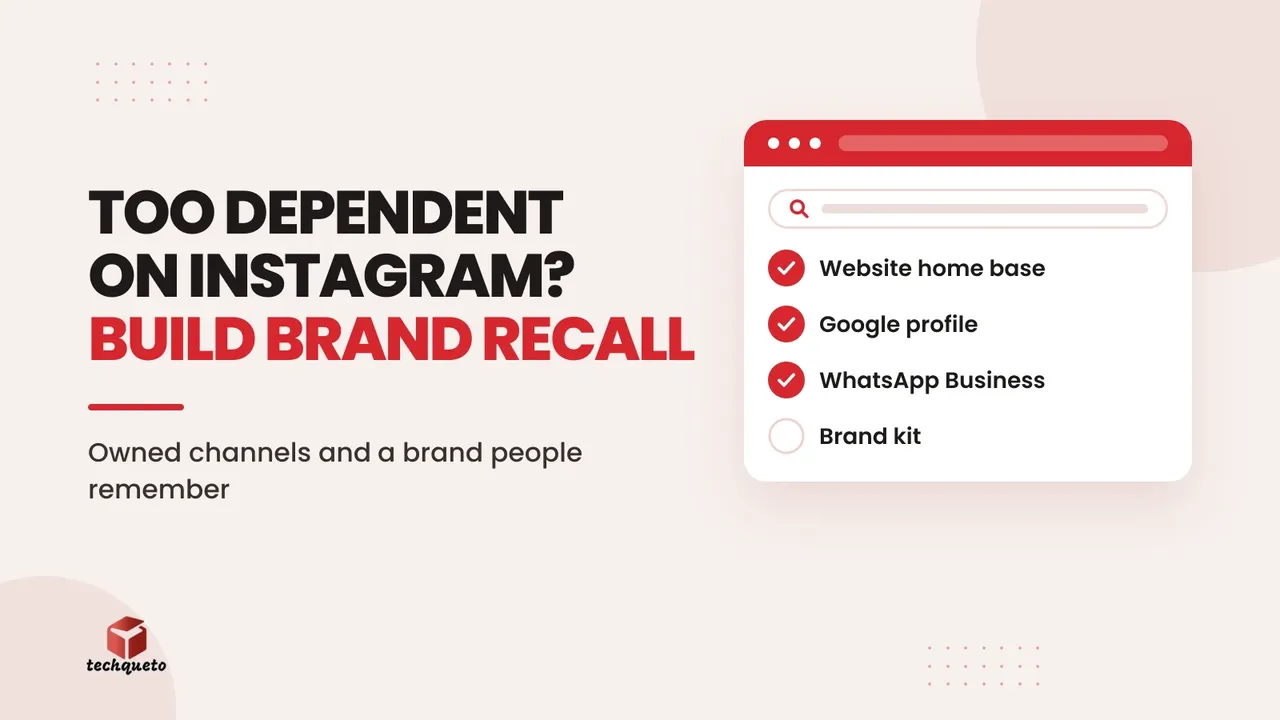
1. A website that works as your home base
Your website is the one place where you control the message, the layout and the next step. It doesn't need to be large. It needs to show what you offer, real work, prices or price ranges where possible, and an easy way to get in touch.
Make your link in bio point to a page that matches what you're posting about, such as a current offer, your catalogue or a portfolio, rather than a generic homepage. If you're seeing visits but few enquiries, our guide on why websites don't generate leads covers the fixes.
2. Google, where people check you
After seeing you on Instagram, many people search for you. A complete Google Business Profile with recent reviews and photos turns that search into trust. It also brings customers who have never seen your posts, people searching for your service nearby. We cover this in detail in why your competitor shows up on Google and you don't.
3. WhatsApp Business, where conversations continue
Most Indian customers would rather chat than fill a form. Move conversations from DMs to WhatsApp Business, where you can set up a catalogue, quick replies and labels, and keep the conversation even if your Instagram account has problems. With customers' permission, broadcast lists let you share offers with past buyers. Click-to-WhatsApp ads can send people from an ad straight into a chat.
4. A customer list you keep
Keep a simple record of every customer: name, phone number, what they bought and when, and whether they agreed to hear from you. Repeat customers and referrals are the cheapest sales you'll ever make, and this list is what lets you reach them without paying a platform.
5. One more channel that fits your audience
You don't need to be everywhere. Pick one more channel where your buyers spend time: LinkedIn if you sell to businesses, YouTube if your work needs explaining, Facebook if your customers are older or community-based. Reuse what works on Instagram, adapted to the format.
Make the brand memorable wherever people meet it
Spreading across channels only helps if people recognise you on each one. Brand recall comes from consistency and from a few distinctive things repeated for long enough.
Keep a simple brand kit and use it everywhere:
- One logo in a few versions (full, icon, light and dark backgrounds).
- Two or three brand colours, with their exact codes written down.
- One or two fonts.
- A tone of voice: are you formal, friendly, expert, playful? Write three words that describe it.
- The same business name, handle, profile photo and description on every platform.
Own something distinctive. A recurring post format, a signature colour, a catchphrase, a mascot or a style of photography. Things people notice before they read your name. Generic AI-generated visuals do the opposite, making you look like everyone else; we explained why AI slop branding is costing brands trust.
Try the recall test. Cover your logo and name on your last nine posts and your website's first screen. Would a regular customer still know they're yours? If not, consistency is the first fix.
Make the website feel like the same brand. A customer who taps from a polished reel to an old, mismatched website feels the drop in quality immediately. The colours, photos and voice should carry across.
What this looks like in practice
Two projects from our work show both sides.
For DDG Living, a luxury interior-design studio, we rebuilt the content engine and grew Instagram from 524 to more than 15,000 followers in three months. The growth mattered because it was paired with a daily lead-generation flow, so attention turned into enquiries instead of staying as followers.
For Arjun Interiors, the plan was built across four channels from the start: Google Business Profile, Facebook, Instagram and LinkedIn, with a phased social media roadmap and Meta ads to drive discovery and inbound leads. If one channel slows down, the others keep enquiries coming.
A 30-day plan
Week 1: audit. List where your last 20 customers came from. Search your business name on Google and note what appears. Check your link in bio. Run the recall test.
Week 2: fix the home base. Update your website's first screen, services and contact options, or build a simple one if you don't have it. Complete your Google Business Profile.
Week 3: move conversations. Set up WhatsApp Business with a catalogue, quick replies and labels. Start a customer list with consent. Ask recent happy customers for Google reviews.
Week 4: make it consistent. Write down your brand kit and update every profile to match. Pick your second channel and plan four posts for it.
How to measure progress
- Enquiries by source: the share coming from Instagram should fall as other channels grow, even if Instagram enquiries themselves stay level.
- Branded searches: Google Search Console shows how many people search your business name. Rising branded searches are a direct sign of brand recall.
- Repeat and referral customers: the clearest sign people remember you.
Keep posting on Instagram. Just make sure that a bad month there is a bad month, not an empty one.
Want a brand and channel plan that doesn't depend on one app? Talk to Techqueto. We connect websites, search, social and WhatsApp into one system for businesses across India and the UAE.