Anthropic has made Claude Code cloud sessions available to eligible subscribers and attached a promotional credit to them. If your agency or dev team writes code for client websites, this matters less for the free money and more for what it lets you try: handing a coding task to an AI that keeps working while your laptop is shut. This guide explains what the offer actually covers, what has already expired, and how to run a sensible cloud-session trial before the remaining credits lapse.
What Anthropic announced
According to BleepingComputer's report, eligible users can now run Claude Code in cloud sessions without joining the research preview. Cloud sessions run on Anthropic-hosted infrastructure, so the work keeps going even when your own computer is off, and you come back later to review the result.
The promotion is limited to individual Pro and Max subscribers who had an active subscription when it began on 23 September. Pro subscribers get $100 in promotional cloud-session credits and Max subscribers get $250. The credits sit separately from your normal usage limits and apply automatically when you start a cloud session.
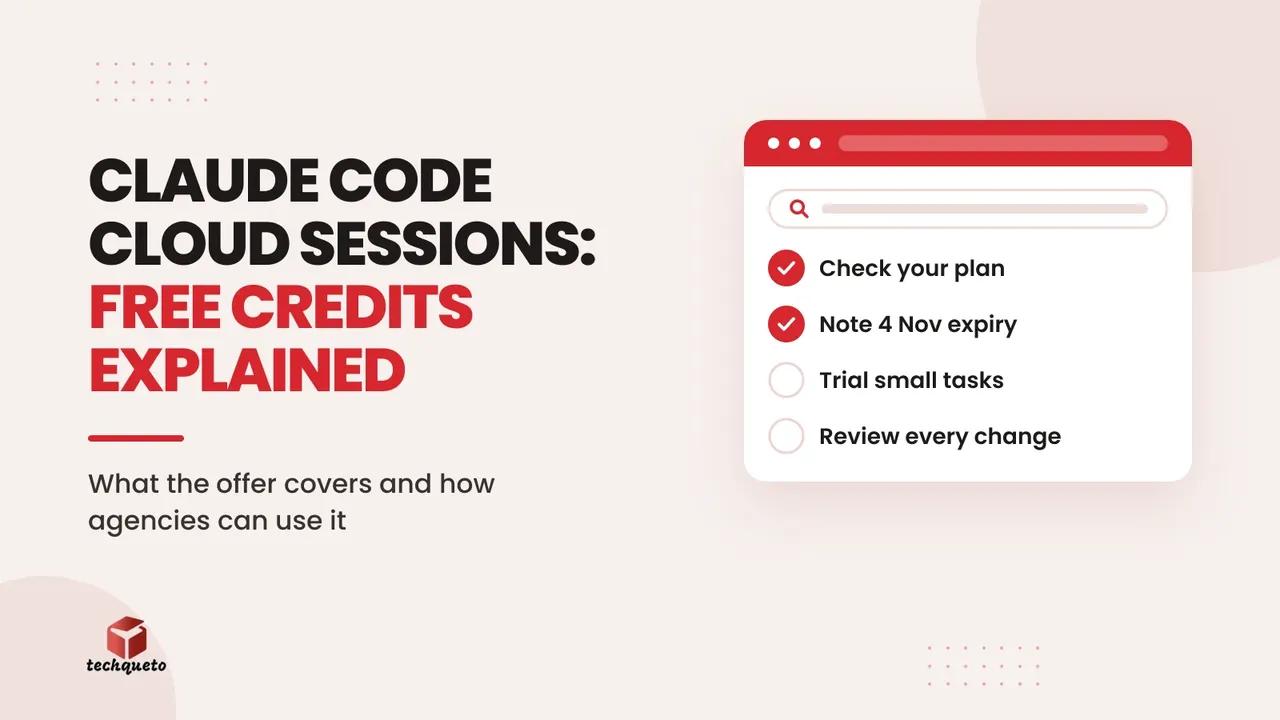
Do this: Check which plan you are on and whether your subscription was active on 23 September. If you are on a team or business plan rather than an individual Pro or Max plan, the offer as reported does not apply to you.
What has already closed, and what is still open
Timing is the part most people will miss. The claim deadline was 7 October, which has passed. Anyone who claimed in time still has a balance until 4 November, when any remaining promotional credit expires. After that, cloud sessions count against your regular plan limits.
So if you claimed, you have a short window left. If you did not, the practical takeaway is different: cloud sessions themselves are still available to eligible subscribers, and the article notes there is no separate charge for the cloud container. You are simply working inside your normal plan limits.
Do this: If you claimed, open your account today and note your remaining balance and the 4 November expiry date. Plan your trial around that date rather than leaving the credit to lapse.
Cloud sessions versus local sessions
A local session runs on your own machine, which means it stops when your laptop sleeps, loses power or leaves the office wifi. A cloud session keeps going on Anthropic's infrastructure. Anthropic's own framing, as quoted in the report, is that if you hit a limit locally you can keep going in the cloud until your credit runs out.
You can start a cloud session from claude.ai/code, the Code section of the Claude mobile app, the desktop app, or the command line using claude --cloud. BleepingComputer says it confirmed the command-line route in its own tests.
For an agency, the difference is about interruptions. A long refactor, a dependency upgrade or a batch of repetitive template fixes no longer depends on someone's laptop staying awake.
Do this: Pick one developer to run the trial from the command line and one non-developer, such as a project manager, to try the mobile app. You will learn quickly which route your team actually uses.
Which agency tasks suit a cloud session
Cloud sessions fit work that is well-defined, tedious and easy to check afterwards. Good candidates for an agency include:
- Upgrading a client site's packages or moving a backend to a newer runtime, as covered in our guide to upgrading from Node.js 20 safely.
- Fixing a batch of accessibility or meta-tag issues across many templates.
- Writing and running tests for an existing feature before you change it.
- Converting a set of static pages into reusable components.
Poor candidates are vague tasks such as "make the site better" and anything that touches production data, payment flows or client credentials.
Do this: Write each task as a short brief with a clear finish line, for example "update these 14 template files to the new component and list anything you could not convert". A precise brief is what makes unattended work reviewable.
A worked example: costing a trial task
Here is a simple way to judge whether a cloud session earns its place. These figures are an illustrative example, not a benchmark.
Suppose a developer on your team costs the agency ₹1,000 an hour, and a template clean-up across a client site takes three hours by hand. That is ₹3,000 of billable-equivalent time. If the cloud session completes most of it and a reviewer needs 45 minutes to check the output, the review costs ₹750. The saving in this example is about ₹2,250, and more importantly the developer spent that time on client-facing work instead.
Now run the honest version: if the review turns up so many errors that the reviewer redoes half the job, the saving shrinks or disappears. That is exactly what a trial should reveal before you build the tool into a client workflow.
Do this: Log three numbers for each trial task: time to write the brief, time to review the output, and time you estimate the task would have taken by hand. After five tasks you will have real figures for your own team instead of guesses.
Keep client work safe
Running code tasks on someone else's infrastructure raises questions your clients may ask. Before you point a cloud session at a client repository, decide what it is allowed to see. Keep secrets, API keys and customer data out of the repository you share, use a branch rather than the main line, and make sure a human reviews every change before it is merged.
If your agency is also exploring how to customise Claude Code for your own workflow, our posts on what Claude Code mods mean for your team and how to create one step by step cover the local side of the same tool.
Do this: Add one line to your project checklist: no credentials in the repo, work on a branch, human review before merge. Make it a rule before the first cloud session, not after.
A simple plan before 4 November
If you have promotional credit, treat it as a free pilot rather than a bonus to burn through. Spend the first week on three small, low-risk tasks from your own internal projects, not a client's. Spend the second week on one real but contained client task with full review. In the last few days, write a one-page summary: what worked, what needed rework, and whether a paid plan makes sense for your team.
Do this: Put a calendar reminder for 1 November so you can review results before the credit expires and decide with data.
The bottom line
Claude Code cloud sessions are a genuine change in how a coding assistant can fit into agency work, because the task no longer depends on a developer's machine staying on. The promotional credit is a time-limited reason to test that honestly: the claim window has closed, any unused balance expires on 4 November, and the lasting value is what your team learns about which tasks are safe to delegate. Run small, review everything and measure the time saved before you rely on it.
Need help with this? Get in touch with Techqueto — we build and grow websites for 100+ brands across India and the UAE. Ready to get started? Get started here.