If you run a clinic, a coaching institute, a store or a services business in India and your team already uses an AI tool for replies, content or admin, this post is for you. Three new models arrived in the last two weeks of October 2026, and the headlines make it sound like you must switch. You don't. By the end you will know which of them you can actually use today, how to work out what a cheaper AI model would save you, and how to test one on your own work in a week.
We use the late-October releases as examples only. The method works whichever model is newest next month.
What launched, and what you can actually use
Not every announced model can be bought. That is the first thing to check, because a model you cannot access is not a decision for your business.
- Gemini 4 Carbon (Google). Google's announcement says access starts with "a subset of cyber defenders" and then trusted partners, and that it will reach developers, businesses and consumers "as soon as possible". It is not generally available, so there is nothing for you to switch to yet. Google lists an introductory price of $2 per million input tokens and $10 per million output tokens, rising to $4 and $20 after the introductory period.
- GPT-6.1 Terra (OpenAI). This one is available. OpenAI's pricing page lists it at $1.00 per million input tokens and $5.00 per million output tokens on the standard tier, with a cheaper batch tier for jobs that can wait.
- Kimi K3.1 Pro (Moonshot AI). Moonshot's launch post says it is live on its own apps and API, and promises open weights "by Nov 4". When we checked, the post did not link to released weights, so treat that as a promise until you see the files.
A token is a small chunk of text, roughly three-quarters of a word in English. Providers bill input (what you send) and output (what the model writes) separately, and output usually costs more.
Cheaper AI models for small business: where the saving is real
For a typical Indian SME, the model fee is a small line item. The saving only matters if you run the same task many times a day. Here is a worked example. The numbers are illustrative, not from any client.
- Your team uses AI to draft first replies to 500 website and WhatsApp enquiries a month.
- Each reply sends about 1,500 tokens in (the enquiry plus your price list and FAQ) and gets about 400 tokens back.
- That is 750,000 input tokens and 200,000 output tokens a month.
- At $1 and $5 per million, that costs about $1.75 a month, or roughly ₹150 at an assumed ₹85 to the dollar.
- At $4 and $20 per million, the same work costs about $7, or roughly ₹600.
Even the dearer option is the price of a cup of tea per day. So the rule for a small team is simple: pay for accuracy and reliability, not for the lowest token price. A cheaper model only changes your costs when you automate thousands of tasks, such as product descriptions for a large catalogue or tagging every incoming lead.
Do this: Before you compare models, count how many times a month your team runs the task. If it is under a few thousand, the fee barely matters. Choose on quality and data handling instead.
Why the benchmark scores shouldn't decide for you
Every launch comes with a table showing the new model winning. Read the small print. Google's announcement quotes scores such as SEC-bench Pro, ExploitGym and CWE-bench. These figures are reported by the companies that built the models, and they measure things like security testing and coding, not writing a polite reply to a patient asking about appointment slots.
Treat benchmarks as a reason to try a model, never as proof it will work for you.
A one-week test on your own enquiries
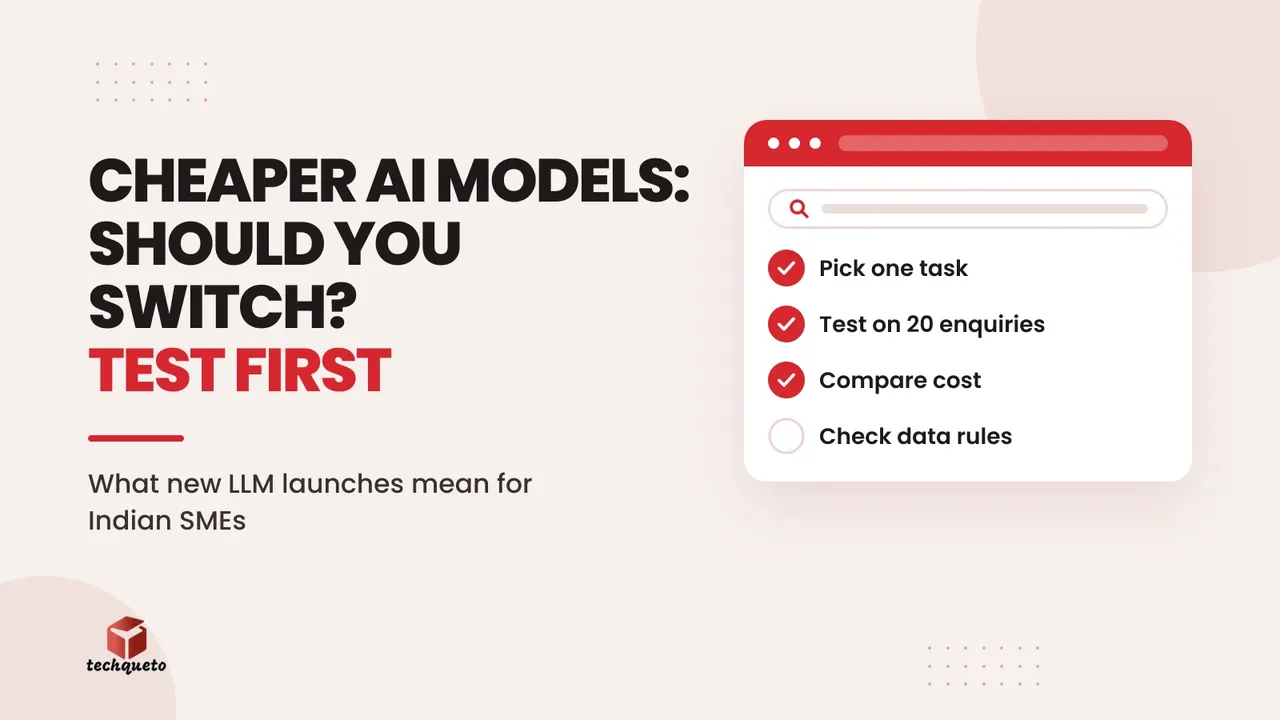
You do not need a technical team to compare two models fairly. Use this checklist.
- Collect 20 real past enquiries or tasks, including two or three awkward ones (an angry customer, a vague question, a price negotiation).
- Remove names, phone numbers and any private details before you paste anything into a new tool.
- Give both models the same instructions and the same reference material, such as your price list and FAQ.
- Have the person who normally handles these tasks mark each answer: usable as is, usable after a small edit, or wrong.
- Note every answer that states a price, a timing or a policy incorrectly. One confident wrong price is worse than ten slow replies.
- Compare the two scores, then the cost per task from your usage numbers.
If the cheaper model scores about the same, move that one task over. If it does not, you have just saved yourself a migration.
What DDG Living shows about tools versus process
When we rebuilt the content engine for DDG Living, a luxury interior-design studio, and built a daily lead-generation flow from it, the account grew from 524 followers to more than 15K in three months, according to our Work page. That growth came from a repeatable weekly process: what to post, who approves it, how enquiries are captured and followed up.
Whichever AI tool sits inside a process like that can be swapped. The process cannot. A business with a clear routine can test a new model in a week and change back without losing anything. A business without one just has a more expensive way of being inconsistent. If you are still building that foundation, our guide to building an AI tool stack worth paying for is a better starting point than any model comparison.
Data and privacy checks before you switch
A cheaper price is no help if the data handling is worse. Check three things before moving any live customer data.
- Where the data goes and whether it is kept. Look for a zero-data-retention or no-training option on the plan you will actually buy. Moonshot, for example, says zero data retention is available to API customers; confirm the same for any provider you consider.
- Who can switch it on. Moonshot's post notes that enterprise admins must enable the model for their organisation. Tools that need an admin to approve them are doing you a favour.
- Where your team uses it. If staff paste customer details into a free consumer app, a model change will not fix that. A short written rule on what may and may not be pasted does more than any model upgrade.
Your next step: one task, two models, one week
Do not rebuild your workflow around this month's launch. Pick the single repetitive task that costs your team the most time, run the one-week test above against your current model and one alternative, and decide on the results. If a model such as Gemini 4 Carbon becomes publicly available later, the same test applies to it without changing a word. If you want help setting that kind of test up for your business, get in touch with us.