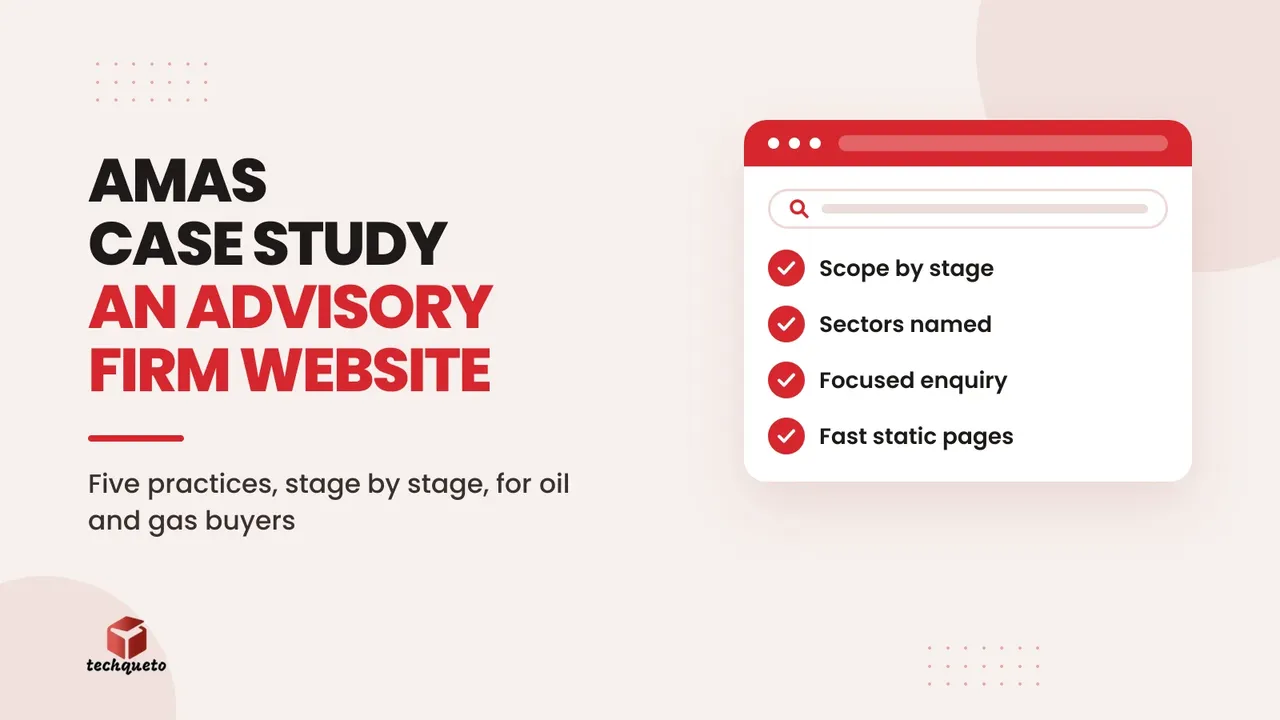
An advisory firm doesn't sell a product you can photograph. It sells experience, method and judgement, to buyers who are engineers and project managers and who read a website the way they'd read a bid document. This case study looks at the corporate website we built for AMAS, an advisory firm working in oil and gas, petrochemical and allied industries, and what other B2B service firms can learn from it.
The facts here come from our work page, where AMAS is listed as a corporate website for a marketing and advisory services firm, and from the live site. We haven't quoted any enquiry numbers, because the point of this piece is how the site is built.
Who AMAS is
AMAS describes itself as a group of senior professionals offering advisory services to the oil and gas, petrochemical and allied industrial sectors, in India and overseas. Its site explains that it works in partnership with engineering consultancies and EPC contracting companies to help deliver demanding projects, and that it also advises equipment and product manufacturers on growing their business in India and abroad.
Its sectors are listed plainly on the home page: oil and gas, EPC companies, refineries, petrochemicals, fuel farms, hydrocarbon pipelines, nuclear power, polyester and petrochemical plants, and captive power.
That's a narrow, technical audience. The people who hire a firm like this already know what a materials management plan or an interface management procedure is. A website that talks down to them, or hides the method behind marketing language, loses them on the first screen.
What a site like this has to do
For an advisory firm, the website mostly has three jobs:
- Show scope precisely. A project director deciding whether to bring in outside advice wants to see exactly which parts of the project lifecycle the firm covers.
- Show standing without fluff. Experience in a sector is the product. The site has to state it clearly and let the reader judge.
- Make the first conversation easy and specific. A good enquiry from an engineering firm already names the scope, the constraints and the timeline. The contact page should ask for exactly that.
Everything on the AMAS site maps to one of those three jobs.
How the site is structured
The site is deliberately small: four pages, Home, About, Services and Contact. There's no blog to keep updated and no menu of a dozen thin pages. For a firm whose buyers will read every word, fewer, denser pages work better than many light ones.
The home page works like a capability statement
The home page opens with one line on who AMAS serves, followed by the team's experience across oil and gas, chemicals, infrastructure and allied sectors, and the management areas it covers: project engineering, project management, financial, materials and business management systems.
Below that, the sectors scroll past in a single band, so a visitor from a refinery project or a pipeline project sees their own world named in the first few seconds.
Five practices, each broken into stages
The core of the site is the services overview, and this is where it differs most from a typical corporate site. Each practice isn't just a heading with a paragraph under it. It's broken into the stages an engineer would recognise:
- Project management across the five stages of a project: initiation, planning, execution, monitoring and control, and closeout.
- Materials management across the supply chain: procurement planning, selecting suppliers and vendors, RFQs for supply items and construction contracts, expediting and material tracking, inspection and testing, shipment and logistics, and onsite receipt and storage.
- Project engineering management across the documents that keep engineering on track: the engineering execution plan, the deliverable list, the SDC and IDC matrix, interface management and coordination procedures, the assumption and hold list, and document control.
- Business development, which covers technology tie-ups and consortium partnerships that help clients qualify for bids, and developing markets for manufacturers and service companies.
- Business management systems, which covers quality, environmental, and health, safety and security management systems.
A project manager can scan that list and know within a minute whether AMAS covers the gap they have. That's the job a services page should do for a technical buyer, and it's far more convincing than "end-to-end solutions".
Standing, stated plainly
A "Why choose AMAS" section lists the kinds of experience behind the team: multinational engineering consultancies, public-sector oil companies, overseas project execution, and delivery across the full project lifecycle. It's short and factual, which suits an audience that's sceptical of adjectives.
A contact page built around a real enquiry
The contact page asks the visitor to "tell us about your project" and to share "the scope, the constraints and the timeline". The form asks for name, company, email and an optional phone number, then has a picker for the area of interest: project management, material management, business development, business management systems, product marketing, or a general enquiry. Then there's a box for the project brief.
That picker matters. An enquiry arrives already sorted by practice, so the right person can answer it without a round of "could you tell us more?".
For visitors who'd rather not fill in a form, the same page gives the office address in Chembur, Mumbai, a phone number, an email address, business hours and a WhatsApp link. In India, a lot of B2B conversations start on WhatsApp, and the site says outright that both email and WhatsApp are fine.
Why plain, fast pages
The AMAS site is built as plain static pages served from a content delivery network, with an edge location in Mumbai. There's no heavy theme, no page builder and no database behind the pages, so there's very little to slow a page down or to break.
That isn't only about speed for its own sake. Google's Core Web Vitals measure loading, responsiveness and visual stability, and those are exactly the things that suffer when a simple corporate site is built on a heavyweight template. Senior people also check a firm's site on their phones between meetings, and Google indexes the mobile version of a site's pages, as its mobile-first indexing guidance explains. A small, fast site does well on both counts.
Static pages also cost very little to host and keep secure. For a firm that wants its website to be dependable rather than a project in itself, that's a real advantage.
What we'd add next
A corporate site is a living thing. These are the next steps we'd recommend for AMAS and for any advisory firm in a similar place:
- Organization structured data. Google's guide to organization structured data shows how to tell search engines a firm's official name, logo, address and contact details. It's a small addition that helps Google present the firm correctly.
- One page per practice. Each of the five practices could grow into its own page with a worked example of a project stage, in the firm's own words. That gives search engines and buyers more to go on, without padding.
- Clear titles and descriptions on every page. Google's SEO starter guide remains the best plain-language checklist for this.
Do this: if you run a B2B service firm, rewrite each service on your site as the list of stages you actually deliver, in the words your buyers use in their own documents. It's the fastest way to sound like you know the work, because you do.
Lessons for other B2B service firms
- Write for the expert in the room. Technical buyers trust method and specifics. Name the stages, the documents and the sectors.
- Keep the site small and dense. Four strong pages beat twenty thin ones, especially when every page is read closely.
- Let the enquiry form do the sorting. One question about the area of interest saves a round of emails and gets the enquiry to the right person.
- Offer the channel people actually use. Email for the formal brief, WhatsApp for the first question.
- Choose boring, fast technology. A simple static build is quick, cheap to run and hard to break.
Do this: read your own contact form as a buyer would. If it doesn't ask for the one thing you'd need to reply usefully, add that question and remove one that isn't needed.
See the site and our other work
You can see the live site at amas.co.in. For more of the websites, campaigns and identities we've built for businesses across India, see our work.