Most Indian apparel brands start on marketplaces, because that's where the shoppers already are. Sooner or later the same question comes up: should we also run our own store, and what should it actually do? This case study walks through what we built for Nanzi Apparel, an apparel brand that now sells through four channels, and what any D2C brand can take from it.
Everything below comes from our work page and from the live store itself. We've left out sales figures on purpose: this post is about how the store is put together, not about numbers we can't show you.
Who Nanzi Apparel is
Nanzi Apparel is a clothing brand. Its live store currently lists men's shirts, trousers and jeans, and its own description calls it "your one-stop destination for fashion and lifestyle products".
Our work with Nanzi went beyond the website. As our work page records, we ran social and marketplace growth for the brand, redesigned its wordmark and worked on a trademark strategy under Class 25. Today Nanzi sells through four channels: its own D2C store, Amazon, Flipkart and Myntra.
That mix shaped the website. A store that sits next to three marketplaces has a different job from a store that is a brand's only shop.
Why a brand on three marketplaces still needs its own store
Marketplaces are good at one thing: putting your product in front of people who are already searching. What they don't give you is the relationship. The customer belongs to the marketplace, the page layout belongs to the marketplace, and so do most of the rules about how you present your brand.
An own store fills those gaps. It's where the brand decides how a collection is grouped, what a returning customer sees, and how a question gets answered. It's also the one place where the brand identity we redesigned shows up exactly as intended, with no marketplace template around it.
So the store isn't a copy of a marketplace listing page. It's built for a customer who already knows Nanzi from a marketplace or from Instagram, so that buying directly is easy and coming back is natural.
How the catalogue is organised
Apparel is a variant-heavy category. One shirt comes in several sizes, and a shopper usually knows the cut they want before they know the colour. The store reflects that.
- Categories follow how shoppers choose. Shirts are split by collar and pattern: button-down collar and mandarin collar, in line and plain versions. Trousers and jeans have their own sections, each with its own collection page.
- Every size is its own item with its own SKU. That's the same discipline the marketplaces enforce, so stock and orders can line up across channels instead of living in separate spreadsheets.
- Search suggests as you type. A shopper who types "mandarin" gets matching products straight away instead of a results page to dig through.
- Collections sit on the home page. Best sellers, featured products, new arrivals and banners for the main collections give a returning visitor something new to look at first.
What happens between "add to cart" and the order
The parts of a store that decide whether someone actually buys are the dull ones: sign-in, payment and what happens after. Each of them is kept short.
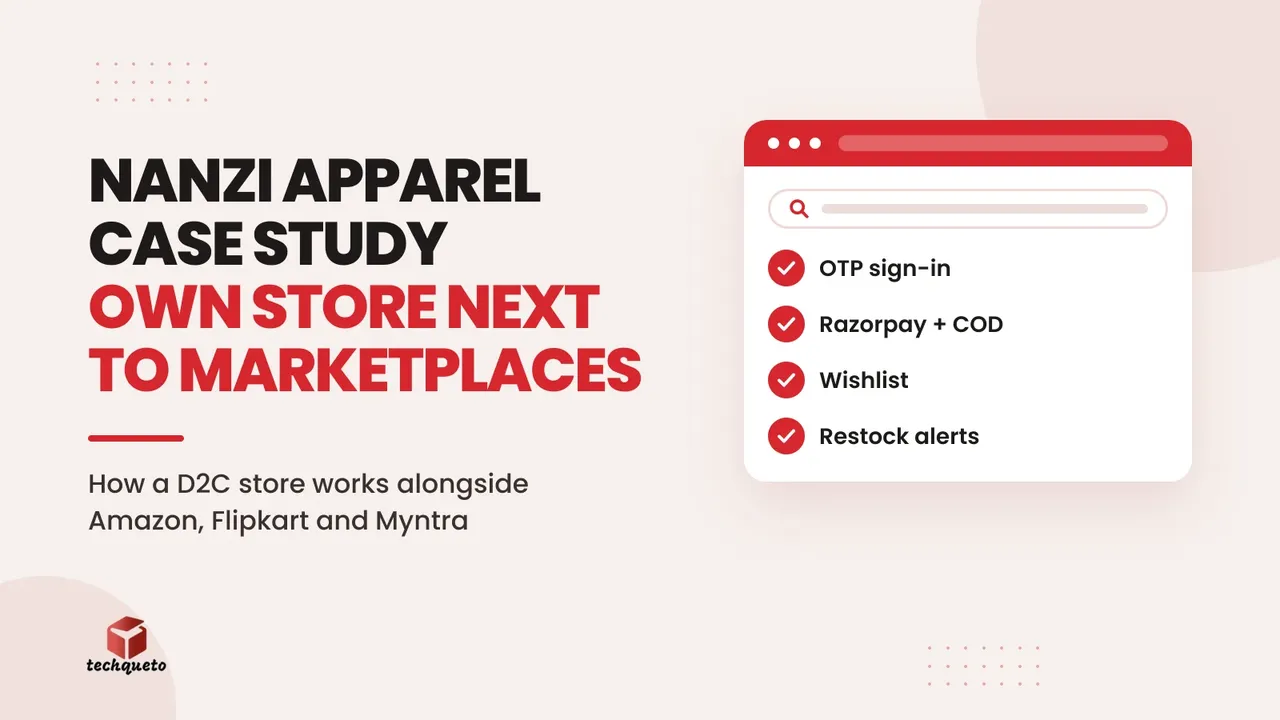
- Sign in with a one-time password. Customers log in with a code sent to their phone instead of creating and remembering a password. For a first-time buyer coming from Instagram, that's one less reason to give up.
- Cart with coupon codes. Discount codes work in the cart, so a campaign or an influencer code can send people straight to the store.
- Two ways to pay. Online payment runs through Razorpay, which handles UPI, cards and other methods Indian shoppers expect, and cash on delivery is also on offer for people who'd rather pay when a brand they're trying for the first time arrives at the door.
- Orders customers can see. Signed-in customers get an order history, can follow an order and can cancel one, without having to message anyone.
The features that bring people back
A marketplace sale is usually a one-off. The own store is built to turn a first order into a second one.
- Wishlists let a shopper save a shirt they aren't ready to buy yet.
- Back-in-stock alerts let a customer ask to be told when a sold-out size returns, instead of leaving for good when their size is gone.
- Product reviews let buyers rate what they bought, which helps the next shopper choose.
- A store page lists the brand's physical stores for people who'd rather see the fabric first.
- A WhatsApp button opens a chat with the brand for a question about fit or delivery. For a lot of Indian shoppers, that's the most natural way to ask.
How the brand work and the store fit together
The wordmark we redesigned for Nanzi appears across the store, its social profiles and its marketplace listings, so a shopper who meets the brand on Myntra and later lands on the website sees the same name and mark.
The trademark side matters for the same reason. Class 25 of the international Nice classification, used in India too, covers clothing, footwear and headwear, and that's the class an apparel brand's mark needs to be protected in. A brand whose name appears on several marketplaces is in a far stronger position against look-alike listings once its mark is protected.
Under the hood
The store is a custom build rather than a hosted template: a Laravel back end with a React front end connected through Inertia, which keeps pages quick to move between once the first one has loaded. A custom build means the store can have exactly the pieces above, such as OTP login, restock alerts and the store page, without a stack of third-party plugins to keep updated.
Fashion shoppers browse a lot on their phones, and Google indexes the mobile version of a site's pages, as its mobile-first indexing guidance explains. So the phone layout isn't a smaller copy of the desktop store: it's the version that matters most for both shoppers and search.
What we'd point any D2C apparel brand at next
A D2C store is never finished. These are the next steps we recommend to any brand in Nanzi's position, Nanzi included:
- Product structured data. Google's guide to product structured data shows how price, availability and reviews can appear right in search results. For a store with many variants, that's one of the cheapest ways to stand out.
- A clean product feed. If the brand ever lists in Google Shopping, Merchant Center's product data specification sets out exactly which fields each product needs. Getting sizes, colours and GTINs right once makes every later channel easier.
- Policy pages that are easy to find. Shipping, returns and exchange rules matter to a first-time buyer more than any banner. They should be one tap away from every product page.
Do this: before building your own store, write down the three things a marketplace can't do for your brand. In Nanzi's store, every feature above serves one of three: the customer relationship, a branded experience, or a reason to buy again.
Lessons for other D2C fashion brands
- Don't compete with the marketplaces, complement them. The own store wins on relationship, not on reach. Build for the customer who already knows you.
- Treat sizes and SKUs as one system. If the own store and the marketplaces describe stock differently, overselling and cancellations follow.
- Make the first purchase easy and the second one likely. OTP login, cash on delivery and WhatsApp lower the first hurdle. Wishlists and restock alerts bring people back.
- Protect the name before you scale it. A trademark in the right class costs far less than winning back a brand name later.
Do this: list every point in your checkout where a customer has to type something, and remove one. Each field you drop is one less reason to leave.
See the store and our other work
You can browse the live store at nanziapparel.com. For more of the brands we've built websites, campaigns and identities for, see our work.