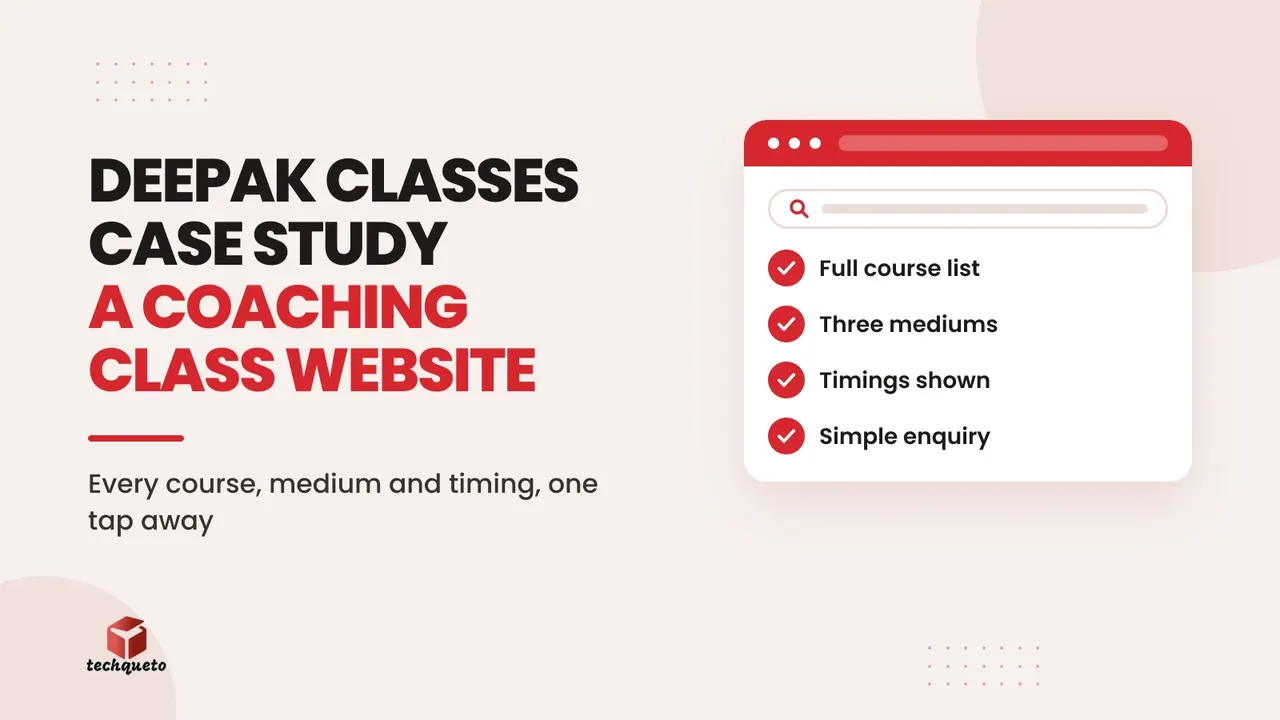
Parents and students choosing a coaching class ask the same few questions every time: do you teach my exact course, in my medium, near me, and how do I get in touch? A coaching institute's website succeeds when it answers those questions faster than a phone call would. This case study looks at the website we built and still maintain for Deepak Classes, a coaching institute in Vashi, Navi Mumbai, and at how it works alongside the social content and enrolment campaigns we run for them.
The facts here come from our work page, which lists our social content and enrolment campaigns for Deepak Classes, and from the institute's own website, whose footer notes that we developed it and maintain it. We haven't included enrolment numbers: this piece is about how the site and the campaigns fit together.
Who Deepak Classes is
By its own account, Deepak Classes was set up in the year 2000 in Vashi. It started with T.Y.B.A. Economics and B.Com, added junior college Arts and Commerce and more degree years in 2002–03, and from 2014–15 added batches for the MPSC, UPSC and IES exams. Its stated aim is to help students acquire knowledge and upgrade their skills, using modern methods.
That history explains the shape of the website. This isn't a single-course academy with one landing page. It's a long-running local institute that teaches school students, junior college students in two streams, degree students in Arts and Commerce, and competitive-exam aspirants. The site has to make all of that findable without overwhelming a parent who only cares about Std 9.
What the website needs to do
For a local coaching institute, the website has three jobs:
- Prove the course exists. Families searching for coaching want to see their standard, stream, subject and medium named on the page.
- Make the institute feel real and local. An address, timings and photos of the classes reassure people who'll be sending a child there several days a week.
- Turn interest into a conversation. Enrolment usually starts with a call or a visit. The site's job is to make that first contact easy.
How the site is structured
The site has four sections: Home, Courses, Gallery and Contact Us. Each one maps to one of the jobs above.
Home: who the institute is and when to visit
The home page introduces the institute and its history from 2000 onwards, the range of courses it offers, and its approach. It also lists the office timings for students, including the separate hours when fees are accepted and the shorter hours during vacations.
That timings block is a small detail that saves the institute a lot of phone calls. Parents planning a visit to ask about admission, or to pay fees, find the answer before they set out. The home page also has a section for top students, which gives families a sense of the results the institute is proud of.
Courses: the full syllabus, level by level
The Courses page is the heart of the site. Instead of a vague "we teach all subjects", it lays out every level the institute teaches and, for most of them, the subjects or papers:
- School: Std 8, 9 and 10, all subjects, in English, Hindi and Marathi medium.
- Junior college, Arts: F.Y.J.C. and S.Y.J.C. subjects, from languages to Geography, History, Political Science, Sociology, Logic and Economics.
- Junior college, Commerce: F.Y.J.C. and S.Y.J.C., including Book-keeping and Accountancy, Organisation of Commerce, Economics, and Maths and Statistics or Secretarial Practice.
- Degree, Arts: F.Y.B.A. and S.Y.B.A. papers listed one by one, and all papers for T.Y.B.A. and M.A. Part I and II across Economics, Sociology, History, English Literature and Political Science, plus M.A. in Education.
- Degree, Commerce: B.Com subjects listed semester by semester.
This level of detail does two things. A parent or student can confirm in seconds that their exact paper is covered. And search engines get real, specific text that matches the way people actually search, such as a particular paper and year, instead of a generic "best coaching classes" page.
The medium matters as much as the subject. A family looking for Marathi-medium Std 10 coaching won't call an institute whose site doesn't say it teaches in Marathi. Naming all three mediums on the page answers that question up front.
Gallery: showing the classes
The Gallery page holds a large set of photos from the institute. For a local class, photos of real classrooms and students are the quickest way to show that the place is established and active. They also give the enrolment campaigns something genuine to point to.
Contact Us: one short form, plus the address
The contact page has a simple message form, the full address in Sector 16, Vashi, a phone number and an email address, with a map. Plenty of enrolment conversations start with a phone call or a walk-in, so the phone number and address matter as much as the form.
How the website and the enrolment campaigns work together
The social content and enrolment campaigns we run for Deepak Classes are one of the ways families hear about a new batch. The website is where they check it out before they call.
That's why the site is built around specifics. A campaign for a junior college Commerce batch can send someone to a page that lists exactly the Commerce subjects taught. Someone who sees an exam-batch post can check the institute's history and timings. The campaign creates the interest, and the site removes the doubts that stop a family from picking up the phone.
Being found locally
A coaching institute lives and dies by its neighbourhood, so local search matters more than national rankings. Google's guidance on local ranking explains that results depend mainly on relevance, distance and prominence. A complete, accurate Google Business Profile, with the same name, address and phone number as the website, is the foundation.
Google indexes the mobile version of a site's pages, as its mobile-first indexing guidance explains, and parents often look up a class on their phones. The site is a set of light static pages served from a content delivery network, so it loads quickly even on a slow connection.
What we'd add next
Because we maintain this site, these are the improvements on our own list, and they apply to most coaching institutes:
- Local business structured data. Google's guide to local business structured data shows how to state an institute's address, phone number and hours in a form search engines read directly.
- Course information in structured form. Google documents course info structured data for course providers. With a syllabus as detailed as this one, it's a natural next step.
- A tidier contact page. Every line on the page should be about getting in touch, with nothing left over from a template.
Do this: list every course you teach the way a parent would type it into Google: standard, stream, subject and medium. If any of those combinations isn't written on your website, add it.
Lessons for other coaching institutes
- Specific beats impressive. A full, honest course list does more than any slogan, because it answers the question families are actually asking.
- Say the medium out loud. In a multilingual city, the teaching language decides who calls you.
- Put the practical details on the home page. Office timings and fee hours save calls and wasted trips.
- Let campaigns and the website do different jobs. Social posts create interest. The website confirms the details. Each should point to the other.
- Keep the site light. Simple pages load fast on any phone and are easy to keep up to date between batches.
Do this: after each new batch announcement, check that the batch, its timing and how to enrol are on the website the same day, so nobody who clicks through from a post finds old information.
See the site and our other work
You can visit the live site at deepak-classes.com. For more of the websites and campaigns we've built for businesses across India, see our work.