If you run a business or manage its marketing, you may have seen "Claude OS" mentioned and wondered whether it is something you should install. This is the first of three posts on the name. After reading it you will know what "Claude OS" refers to, why it is not something most small businesses should deploy, and how to check any AI project on GitHub before you let it near your customers or your data.
What "Claude OS" actually refers to
We could not find an official operating system from Anthropic with this name. What turns up are third-party projects that borrow it. Two are worth separating, because they are very different things.
- The Phidata/Agno repository. The GitHub project agno-agi/claude-os is described as "Claude Operating System". Its README says it contains the code for running that system and is titled "Claude Sonnet 3.5 OS (by Phidata)". It is a Streamlit app that uses Claude Sonnet 3.5, with PgVector for long-term memory and knowledge. To run it you need Python, an Anthropic API key, and Docker for the database. It is licensed Apache-2.0, and the page shows it has been archived by its owner and is read-only.
- A personal project write-up. A portfolio page describes another "Claude OS": a wrapper on Claude Code that adds persistent memory, coordination between several Claude sessions, and calendar, contacts and email tools. Its author says they use it to manage their own job search. The page is a description of a personal setup, not an install guide, and it states no licence.
Neither is a product a business can buy, subscribe to or get support for. The shared name is a coincidence of branding, not a sign that they are related to each other or to Anthropic.
What this means for a small business
The practical consequences are simple. An archived repository gets no bug fixes and no security patches, so anything you run from it is yours to maintain. A project built around Claude Sonnet 3.5, as its own README says, is tied to the choices its authors made at the time. And a personal project is shaped around one person's workflow, which may look nothing like a clinic, a coaching class or a retail shop.
That does not make them useless. They are good places to learn ideas, and the next two posts in this series take two of those ideas: how plain markdown files can act as an assistant's memory, and how to set safety rules for an assistant that can act on your behalf. But reading about a project is different from running it on your business data.
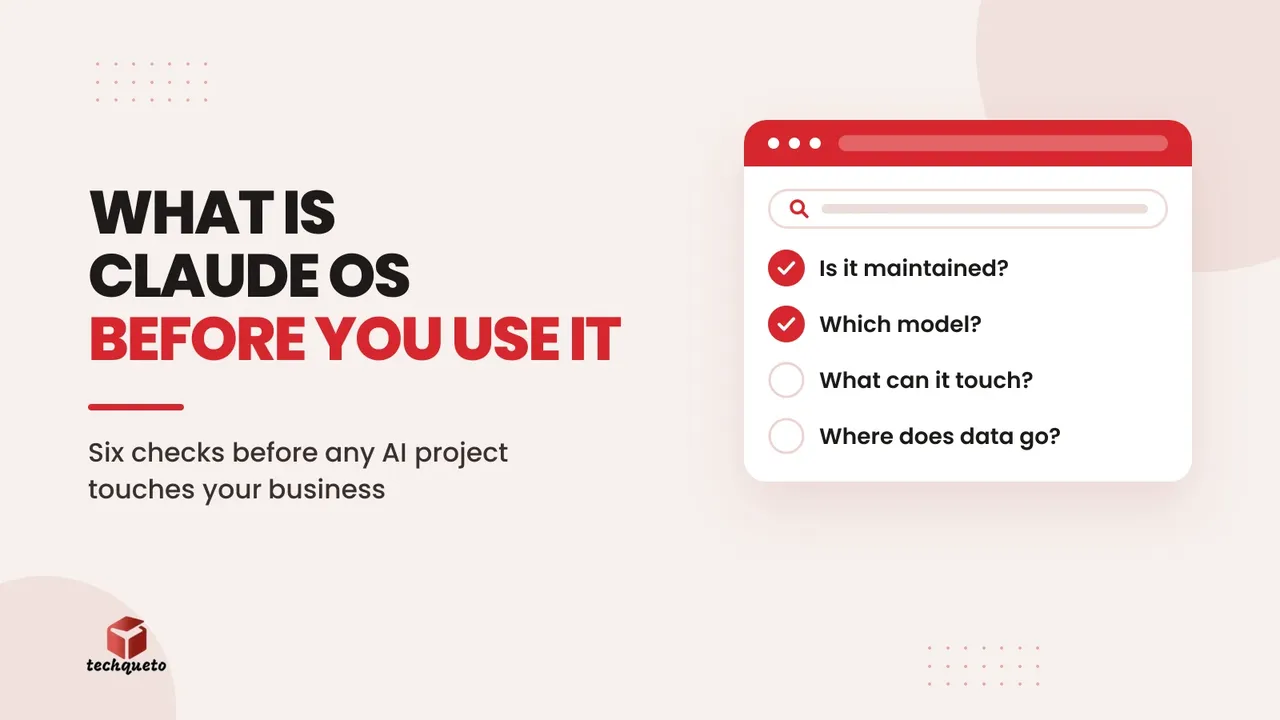
Six checks before you use any AI project from GitHub
Use this list for "Claude OS" or for anything else you find online:
- Is it maintained? Look for an archive notice, the date of the last update, and whether issues are being answered. Read-only means nobody will fix a security hole.
- Which model does it depend on? If the README names a specific model, ask whether that is still what you would choose, and whether a model change would break it.
- What does it need to run? API keys, Docker, a database and a server all mean someone must set them up and keep them running. Name that person before you start.
- What is the licence? Apache-2.0 allows commercial use under stated conditions. If no licence is stated, you generally have no permission to use the code at all.
- What can it touch? Shell tools, email, calendars and files are all access. Decide which, if any, you are willing to give.
- Where does your data go? Check where memory is stored and which outside services (model providers, search APIs, embedding services) receive your customers' details.
A worked example: is it worth the upkeep?
The figures below are an example only, not a benchmark. Suppose a self-run assistant saves a small team 5 hours a week of enquiry-handling time, valued at ₹300 an hour. That is ₹1,500 a week, or about ₹6,000 over four weeks.
Now count the running cost. Say someone spends 3 hours a month on updates and fixes at ₹600 an hour (₹1,800), and API and server costs come to ₹2,000 a month. That is ₹3,800 a month, leaving a net gain of about ₹2,200. If the project is archived and you need an extra 3 hours a month for fixes, the gain shrinks quickly. The point is not the numbers: it is to write the upkeep down before you decide.
Why your own information matters more than the tool
When we built the website for Deepak Classes, a coaching institute in Vashi, a large part of the work was getting plain information right: a full course list from Std 8 to MA, the medium of teaching, and a simple enquiry form. That is the kind of material any assistant, human or AI, needs in order to answer a parent's question correctly.
An assistant can only answer from what your business has written down. If your course list, prices policy and timings are scattered across chats and old brochures, no tool will fix that. If you want a hand with practical, low-risk uses of AI, see our AI services.
Treat Claude OS as a source of ideas, not a download
Use the two Claude OS projects the way you would use a competitor's brochure: to spot ideas worth borrowing, not as software to run your business on. Run the six checks on anything you are tempted to install, and put your own business information in order first.