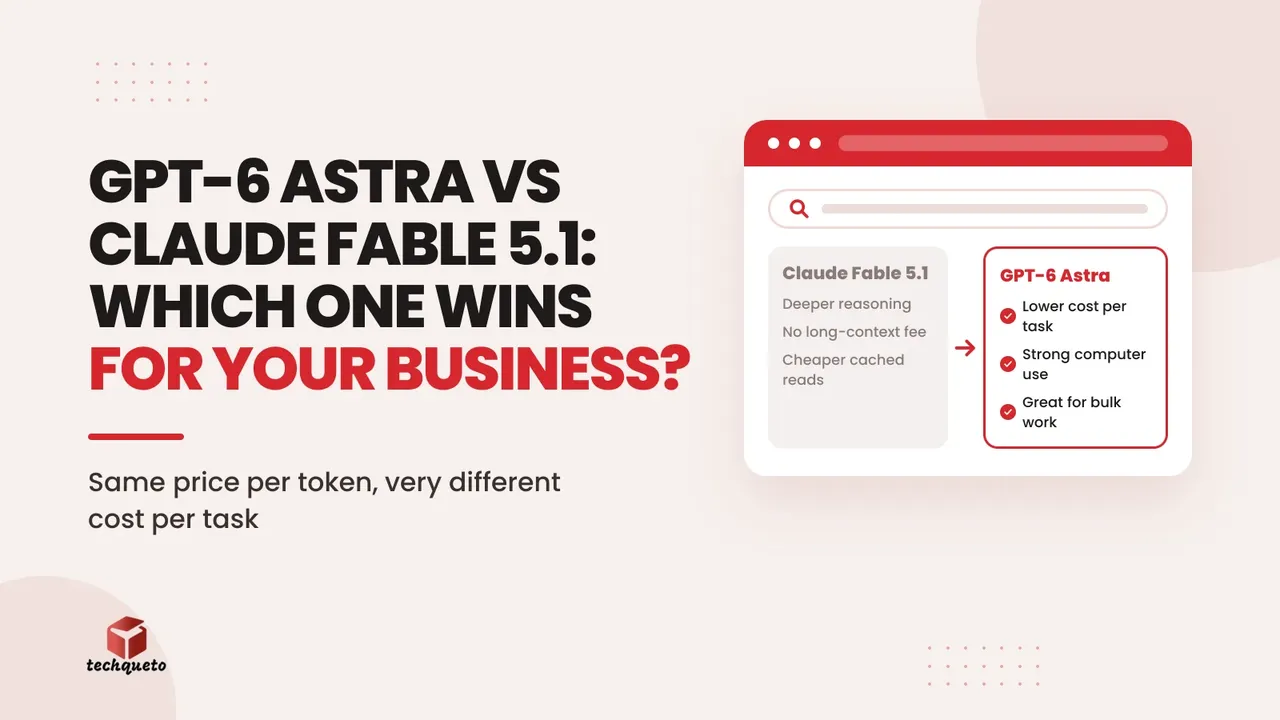
Two flagship models landed within days of each other: Claude Fable 5.1 on 1 September 2026 and OpenAI's GPT-6 Astra on 3 September. If you are choosing between GPT-6 Astra vs Claude Fable 5.1 to run lead qualification, reporting or content workflows, the headline price will not help you, because it is identical.
GPT-6 Astra vs Claude Fable 5.1: the list price is a tie
Both models charge $10 per million input tokens and $50 per million output tokens, with a 50% discount for batch jobs. Both offer a context window of about a million tokens. On a price sheet, there is nothing to separate them, so the decision comes down to how each one behaves on your actual work.
Do this: ignore the per-token price in your first comparison and ask what one finished task costs.
Cost per task is where Astra pulls ahead
Astra uses far fewer tokens to reach an answer. In Artificial Analysis' independent comparison, a task at maximum effort cost about $1.67 on Astra against $3.76 on Fable 5.1. OpenAI's own published results also show Astra ahead on computer use and on automation-style benchmarks, which matters if you want an agent that clicks through dashboards or fills spreadsheets.
Do this: for high-volume, repetitive jobs such as product-feed clean-up or report drafting, test Astra first.
Where Fable 5.1 still wins
Fable 5.1 leads the same independent index on overall intelligence, 66 against 61. It also has no surcharge on requests above 272,000 tokens, while Astra's rates rise sharply past that point, and its cached input reads are cheaper ($0.25 against $1.00 per million). That combination suits long-document analysis, such as a year of ad reports or a full website audit, and agents that reuse the same context repeatedly. Note that most of the benchmark tables you will see are published by the vendors themselves, so treat the independent figures as the safer guide.
Do this: if your workflow feeds the model large documents or loops on the same context all day, price it on Fable 5.1 before assuming Astra is cheaper.
Test both on your own work
Pick ten real tasks from your business, run them on both models with the same instructions, and record cost, quality and how much human editing each result needed. If you are still deciding between chat tools rather than APIs, our guide to Claude vs ChatGPT for marketing covers that side.
Do this: keep your workflow model-agnostic so you can switch when the next release changes the maths.
The bottom line
There is no single winner. Astra looks like the better value for high-volume, tool-driven automation, while Fable 5.1 is the stronger pick for deep reasoning and long-context work. The firms that benefit most will be the ones that measure cost per outcome on their own tasks instead of following the launch-week headlines.
Need help with this? Get in touch with Techqueto — we build and grow websites for 100+ brands across India and the UAE. Ready to get started? Get started here.