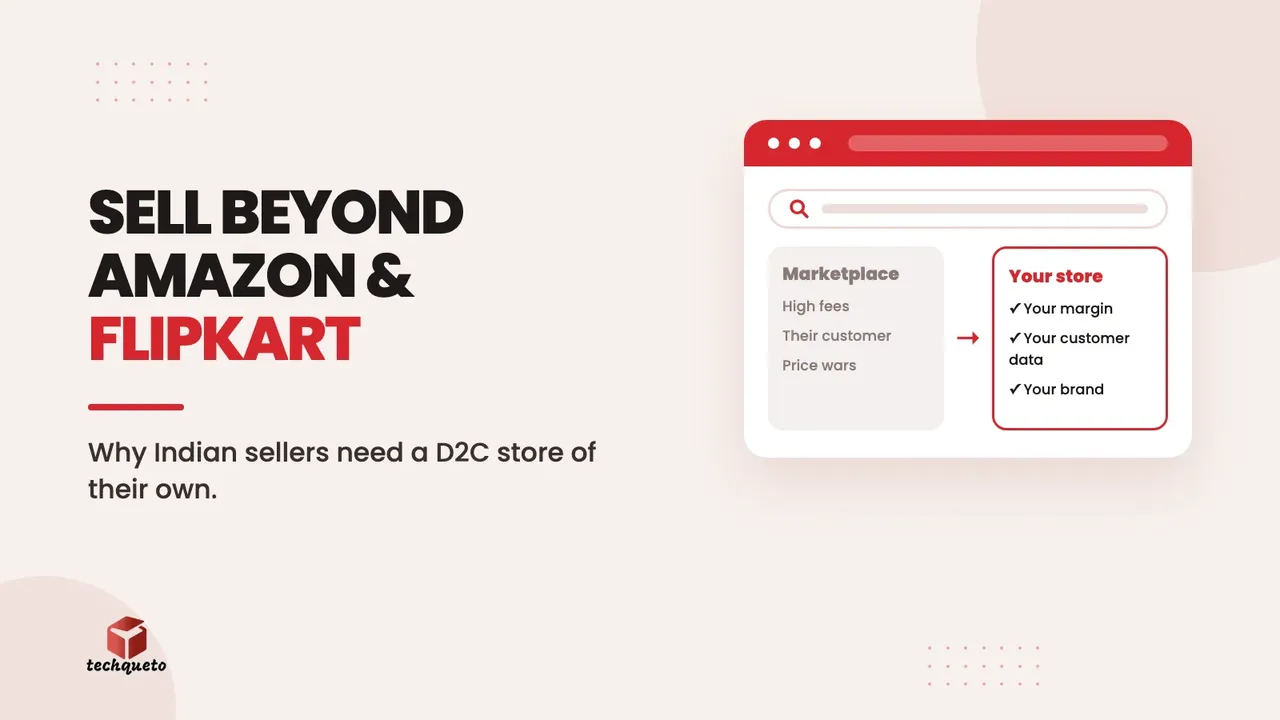
For most Indian product brands, Amazon and Flipkart are where the volume is. They bring shoppers you could never reach alone, handle much of the trust problem, and in big sales they can deliver a quarter's revenue in a week. But you rent that demand. Fees, penalties and ranking rules can change your margins with a few weeks' notice, you rarely get the buyer's contact details, and the next order from the same customer goes through the marketplace's fee sheet again.
A D2C website won't replace the marketplaces for most sellers, and it shouldn't try to. It's the counterweight: a channel where you keep the margin and the customer relationship. This guide covers how to see your real marketplace economics, protect them during sale season, and build your own store alongside.
Know your real margin on each channel
Many sellers price from a fee sheet they looked at once. Rebuild your contribution margin per order for each marketplace, per product, including:
- referral or commission fees and closing fees,
- shipping and packaging,
- payment and collection costs, including cash on delivery,
- returns and return-to-origin (RTO) losses, as a percentage of orders,
- the ad spend it takes to sell the product there,
- penalties and cancellation fees (more on these below).
Then compare it with what a direct order on your own site would leave after payment gateway fees, shipping and your own ad spend. The gap is the value of moving a share of repeat customers to a channel you own.
Penalties can wipe out a sale's profit
Marketplaces have moved towards penalties tied to order value and dispatch performance. As Outlook Business reported, in 2026:
- Amazon began charging Easy Ship and Self Ship sellers an order-cancellation fee scaled to order value: 10% under ₹10,000, 8% from ₹10,001 to ₹50,000, 5% from ₹50,001 to ₹1 lakh and 2% above that, plus GST. It applies whether you cancel or Amazon auto-cancels an order you didn't ship in time.
- Flipkart introduced a dispatch penalty ladder: ₹30 for missing the dispatch-by date, ₹60 for cancelling after an order arrives, and ₹90 for both, with new sellers exempt for their first three months.
Check the current fee and penalty pages in Seller Central and the Flipkart seller hub before relying on these numbers, since both platforms revise them. The lesson holds regardless: a single stockout during a busy weekend can now cost real money, not just a bad account-health score. Sync inventory at least twice a day during sales, build a buffer into your ship-by dates, and track orders nearing their dispatch deadline hours ahead, not minutes. For your thinnest-margin products, pausing them during a sale can be safer than risking a penalty that eats the order's entire profit.
Prepare for sale season with numbers, not gut feel
Big sales such as Flipkart's Big Billion Days and Amazon's Great Indian Festival reward sellers who prepare in the month before:
- Stock. Rather than doubling everything because last year went well, rank products by revenue and stock your top movers more aggressively, leaving slow movers at normal levels. Look at hourly sales from previous sales, not daily, because demand is front-loaded in the first hours.
- Pricing. Set discount depth from your recalculated margin, so a deep discount doesn't turn every order into a loss once fees, returns and ads are counted.
- Listings. Fix your top 20 to 30 products while catalogue approvals are still quick: clear titles, specific bullets, complete attributes and good images. Our guide to getting products found by AI shopping assistants covers how Amazon's Rufus reads listings.
- Returns. Budget for higher returns and RTO after a sale, and if you self-ship, agree reverse-pickup terms with your courier before volumes arrive. Sellers who plan only for the sale and not the two weeks after often hit a cash-flow gap just when they need to restock.
What a D2C website gives you
Your own store gives you three things marketplaces can't:
- The full margin, minus payment fees, shipping and your own marketing.
- The customer relationship: email, phone and WhatsApp consent for repeat sales, launches and feedback, without paying a marketplace again for the same customer.
- Control: your brand presentation, pricing, bundles, content and policies, free from someone else's ranking rules.
It also comes with work: you have to bring the traffic, build trust from scratch and run the checkout, payments and support. That's why the best approach is gradual. One low-cost way to start bringing traffic is Google's free product listings in Merchant Center, which can show your products on Google without paying for ads.
Start with your best products, not the whole catalogue
Launch with hero products and offers that are hard to compare against marketplace listings: exclusive bundles, bigger packs, combos with a free add-on, or a subscription for consumables. These give shoppers a reason to order direct without starting a price war with your own marketplace listings.
Each product page needs its own description (not copied from the marketplace), real photos, genuine reviews and product structured data, so Google and AI shopping tools can read it. A fast mobile checkout with UPI, cards and cash-on-delivery options matters more than an elaborate design.
When a D2C site isn't worth it yet
A store of your own isn't the right first move for every seller. If you have only a handful of low-priced products, little repeat purchase, and no budget or time to bring traffic, a website can sit unused while costing money each year. In that case, put the effort into marketplace listings and a WhatsApp catalogue for repeat buyers first, and build the store once you have products people reorder or bundles worth buying direct.
Turn marketplace buyers into direct customers, carefully
Sale season is when you acquire the most new customers all year, which makes it the best moment to start a list you own. The usual method is a packaging insert: a card or QR code offering a small perk (a discount on the next order, early access to new launches) for reordering on your website or joining your WhatsApp catalogue.
Follow each platform's rules on contacting customers. Don't message buyers through the marketplace to move them off it, and don't put your website or phone number where the marketplace forbids it. An insert that adds value for the customer is the accepted route.
Two brands on our work page show both ends. For Nanzi Apparel, an apparel brand, we ran social and marketplace growth across four sales channels: its own D2C store plus Amazon, Flipkart and Myntra. For TeaOx, a tea brand, the work was its online store and social growth. Running a mix is normal; what matters is knowing what each channel actually earns.
A worked example
These figures are illustrative, not from a real seller. A home-décor brand sells a ₹1,200 cushion set on a marketplace. After commission and fees (₹250), shipping (₹90), returns averaged across orders (₹70) and marketplace ads (₹180), it keeps ₹610 before product cost. The same order on its own site costs about ₹30 in payment fees, ₹90 in shipping, ₹40 in returns and, for a repeat customer reached through WhatsApp, almost nothing in ads: it keeps about ₹1,040.
If 5% of 4,000 festive marketplace buyers scan the insert and 60% of those reorder twice a year directly, that's 120 customers placing 240 orders worth around ₹430 more each, roughly ₹1 lakh a year in extra contribution, from cards that cost a few rupees each.
Build the asset step by step
Marketplaces are a sales channel; your website is an asset that grows in value with every customer who comes back to it. Keep selling where the demand is, protect your margins with honest numbers and good operations, and use each sale season to move a few more customers into a relationship you own.